
The Living World Notes
Study Notes
Topics
5📖 1. Chapter Overview
Overview
The Living World introduces biology by asking a deceptively simple question: what is living? NCERT explains that living organisms show growth, reproduction, metabolism, cellular organisation and consciousness, but no single property alone can define life perfectly. The chapter then shifts to biodiversity, because Earth contains millions of different organisms that must be identified, named and classified scientifically. Taxonomy deals with identification, nomenclature and classification, while systematics also studies evolutionary relationships. Taxonomic categories arrange organisms in a hierarchy from species to kingdom. Binomial nomenclature, introduced by Carl Linnaeus, gives every organism a universal two-word scientific name. For NEET, this chapter is concept-based and frequently tests NCERT lines, examples, taxonomic hierarchy and naming rules.
- 1NCERT stresses that living organisms are self-replicating, evolving and self-regulating interactive systems.
- 2Growth by increase in mass also occurs in non-living objects, so growth alone is not a defining property.
- 3Reproduction is absent in some living organisms such as sterile worker bees, mules and infertile humans, so it is not universal.
- 4Metabolism occurs only inside living cells and is absent in non-living systems.
- 5Consciousness, especially response to stimuli, is considered the most obvious feature of life.
- 6Taxonomic categories are not arbitrary; they represent real biological relationships.
- 7Correct scientific naming prevents confusion caused by different local names.
Hierarchy Mnemonic
King Philip Came Over For Good Soup = Kingdom, Phylum, Class, Order, Family, Genus, Species. Reverse it for bottom-to-top NCERT order: Species to Kingdom.
Taxonomy Trio
I-N-C = Identification, Nomenclature, Classification. These three form the core activities of taxonomy.
Complete Classification Example
Human: Animalia → Chordata → Mammalia → Primata → Hominidae → Homo → Homo sapiens.
Scientific Naming Example
Mango is written as Mangifera indica. Mangifera is the genus and indica is the specific epithet.
Living Feature Example
A seed appears inactive but is living because it has cellular organisation and can resume metabolism under favourable conditions.
Calling reproduction a defining property
Do not mark reproduction as universal because sterile worker bees, mules and infertile humans are living but cannot reproduce.
Confusing taxonomy and systematics
Taxonomy is identification, nomenclature and classification; systematics is broader because it includes evolutionary relationships.
Writing scientific names incorrectly
Genus must begin with a capital letter, species epithet with a small letter, and the name must be italicised or separately underlined when handwritten.
This is not a mathematical formula but a NEET-friendly checklist for recognising living systems. Metabolism and cellular organisation are most fundamental.
Variables
Cellular organisation=Body is made of one or more cells with organised internal structure
Metabolism=Sum of all chemical reactions occurring in the body
Consciousness=Ability to sense and respond to environmental stimuli
🌍 2. What is Living?
Overview
Living organisms are highly organised systems capable of interacting with their surroundings. NCERT discusses growth, reproduction, metabolism, cellular organisation and consciousness as major characteristics. Growth occurs in living organisms by internal cell division, but increase in mass can also occur in non-living objects such as mountains, so growth alone is not enough. Reproduction is common but not universal because some living organisms are sterile. Metabolism is the sum of all chemical reactions inside the body and is a defining feature of life. Cellular organisation is essential because all living organisms are made of cells. Consciousness, or response to stimuli, is the most obvious feature and includes responses to light, temperature, chemicals, touch, water and other organisms.
- 1Increase in mass and increase in number are twin characteristics of growth.
- 2In multicellular organisms, growth occurs by cell division; in plants it can continue throughout life in meristematic regions.
- 3Unicellular organisms grow and reproduce by cell division, so growth and reproduction can overlap.
- 4Isolated metabolic reactions can occur in test tubes, but they are not living because they lack cellular organisation.
- 5Consciousness includes response to external stimuli and internal regulation.
- 6Diversity of life means living forms differ greatly in size, shape, habitat, nutrition and reproduction.
Life Features Mnemonic
GReMeC: Growth, Reproduction, Metabolism, Cellular organisation, Consciousness. Remember: MeC is most defining for NEET.
Reproduction Exception Trick
S-M-I = Sterile worker bees, Mules, Infertile humans. These are living but do not reproduce.
Plant Consciousness
Mimosa pudica folds its leaves when touched, showing response to stimulus even without a nervous system.
Metabolism Example
Respiration in cells breaks glucose to release energy, while protein synthesis builds complex molecules.
Diversity Example
A bacterium, banyan tree, mushroom, mosquito and human are all living but differ hugely in size, organisation and mode of nutrition.
Assuming growth always means life
Crystals and mountains can increase in size, but their growth is external and not due to cellular metabolism.
Ignoring unicellular organisms
In unicellular organisms, cell division is both growth and reproduction, so the distinction becomes blurred.
Treating in vitro metabolic reactions as living
A chemical reaction outside a cell is metabolic in nature but is not a living system because it lacks cellular organisation.
Metabolism is the total of building and breakdown reactions occurring inside living cells.
Variables
Anabolism=Constructive reactions that build complex molecules from simpler molecules
Catabolism=Breakdown reactions that release energy by converting complex molecules into simpler molecules
🌿 3. Biodiversity
Overview
Biodiversity means the variety and variability of living organisms. It includes diversity at genetic, species and ecosystem levels. Earth contains an enormous number of organisms, many of which are still unknown, so biology needs a systematic method to identify, name and classify them. India is especially important because it has rich climatic, geographical and ecological variation, supporting forests, grasslands, deserts, wetlands, mountains, rivers and marine ecosystems. Biodiversity is important for ecological balance, food, medicine, agriculture, oxygen production, nutrient cycling and cultural value. For NEET, biodiversity in this chapter is mainly connected to the need for taxonomy: without scientific study, organisms cannot be correctly identified, compared, conserved or used.
- 1Biodiversity is not only the number of species; it also includes variation within species and between ecosystems.
- 2Species richness refers to the number of species present in an area.
- 3Genetic diversity helps populations adapt to changing environments.
- 4Ecosystem diversity includes variety of habitats such as forests, deserts, wetlands and oceans.
- 5The need to study biodiversity arises because organisms are numerous, varied and distributed across different habitats.
- 6Correct identification is the first step in studying or conserving any organism.
Three Levels Trick
GSE = Genes → Species → Ecosystems. Start from smallest variation and move to largest ecological variety.
Why Study Biodiversity?
N-I-C-E: Name, Identify, Classify, Explore uses. This explains why taxonomy becomes necessary.
Genetic Diversity Example
Different varieties of rice differ in grain size, taste, disease resistance and climate tolerance.
Species Diversity Example
A pond may contain algae, fish, insects, snails, frogs, bacteria and aquatic plants.
Ecosystem Diversity Example
India contains deserts, rainforests, mangroves, alpine meadows and coral reefs, each with distinct organisms.
Equating biodiversity only with animals
Biodiversity includes plants, animals, fungi, bacteria, protists and genetic variation within species.
Ignoring genetic diversity
Two individuals of the same species can differ genetically; this variation is important for adaptation and breeding.
Forgetting India examples
NEET may test the idea that India's varied habitats contribute to high biodiversity, even if exact numbers are not asked from this chapter.
A simple measure often used to compare biodiversity of two regions.
Variables
Species=Different kinds of organisms capable of being recognised as separate biological units
Area=The habitat, ecosystem or region being studied
🧬 4. Taxonomy & Systematics
Overview
Taxonomy is the science of identification, nomenclature and classification of organisms. Identification means finding the correct name and place of an organism by comparing its characters with known organisms. Nomenclature gives a standard scientific name, and classification groups organisms based on similarities and differences. Systematics is broader than taxonomy because it also considers evolutionary relationships. To study biodiversity, biologists use taxonomic aids such as herbaria, botanical gardens, museums, zoological parks and keys. Herbaria preserve dried plant specimens, botanical gardens maintain living plant collections, museums preserve plant and animal specimens, zoological parks keep live animals, and keys help identify organisms through contrasting characters. This topic is highly NCERT-based for NEET.
- 1Systematics comes from the Latin word systema, meaning systematic arrangement.
- 2Taxonomic aids are practical tools used by students and researchers for correct identification.
- 3A herbarium sheet usually contains date, place of collection, local name, scientific name, family and collector's name.
- 4Botanical gardens are useful for plant identification because each plant is labelled with scientific and family names.
- 5Museums often preserve animals in preservative solutions or as dry specimens.
- 6Zoological parks allow observation of wild animals in protected environments.
- 7Keys are analytical tools based on contrasting characters, with separate keys for each taxonomic category.
Taxonomic Aids Mnemonic
HeBoMuZooKey = Herbarium, Botanical garden, Museum, Zoological park, Key.
Taxonomy vs Systematics
Taxonomy tells Name and Group; Systematics tells Name, Group and Family History.
Herbarium Example
A collected flowering plant is dried, pressed, mounted on a sheet and labelled with its scientific name and collection data.
Botanical Garden Example
A labelled mango tree in a botanical garden may show Mangifera indica and its family Anacardiaceae.
Key Example
If a plant has parallel venation choose one lead; if it has reticulate venation choose the contrasting lead.
Calling keys storage centres
Keys are not storage places; they are analytical tools for identification based on contrasting characters.
Mixing museum and zoological park
Museums preserve specimens; zoological parks maintain live animals under human care.
Forgetting herbarium label data
A herbarium sheet is incomplete without collection place, date, scientific name, family and collector details.
The three operations form the central framework of taxonomy in NCERT.
Variables
Identification=Finding correct identity of an organism
Nomenclature=Assigning a standard scientific name
Classification=Grouping organisms based on characters
📚 5. Taxonomic Categories
Overview
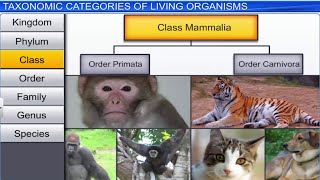
Taxonomic categories are the ranks used to classify organisms in a hierarchy. Each category represents a rank or level, and all categories together form the taxonomic hierarchy. Species is the basic and lowest category, containing individuals with maximum similarity and the ability to interbreed under natural conditions. Related species form a genus, related genera form a family, related families form an order, related orders form a class, related classes form a phylum in animals or division in plants, and related phyla or divisions form a kingdom. As we move from species to kingdom, similarity decreases and number of organisms increases. NEET frequently tests the correct order, definitions and examples such as human, housefly, mango, wheat and potato.
- 1Taxon is any taxonomic group or category at any rank.
- 2Species has the maximum number of shared characters among members.
- 3A genus may be monotypic with one species or polytypic with many species.
- 4Family names in plants often end with -aceae, while animal family names often end with -idae.
- 5Order groups families showing a few similar characters.
- 6Phylum or division is a broad category based on fundamental body plan or plant characters.
- 7Kingdom includes organisms sharing only very broad characteristics.
Top-to-Bottom Mnemonic
King Philip Came Over For Good Soup = Kingdom, Phylum, Class, Order, Family, Genus, Species.
Bottom-to-Top Mnemonic
Smart Girls Find Out Clever People Kindly = Species, Genus, Family, Order, Class, Phylum, Kingdom.
Plant vs Animal Rank
Animals have Phylum; Plants have Division. Remember: Animal body plan = Phylum, Plant group = Division.
Genus Example
Solanum includes potato, brinjal and other related species, so it is a genus containing multiple species.
Family Example
Several related genera are grouped into a family; in plants many family names end with -aceae.
NEET Comparison Example
Two organisms in the same genus are more similar than two organisms in the same family only.
Reversing genus and species
Genus is higher than species. Homo is genus; Homo sapiens is species name.
Thinking higher rank means more similarity
Higher rank includes more organisms but fewer common characters. Species has maximum similarity.
Using phylum for plants in NCERT context
NCERT commonly uses division for plants and phylum for animals.
This is the NCERT sequence from lowest to highest category.
Variables
Species=Basic unit with maximum similarity
Genus=Group of related species
Kingdom=Highest broad category
🏷️ 6. Binomial Nomenclature
Overview
Binomial nomenclature is the two-word scientific naming system used globally for organisms. It was popularised by Carl Linnaeus and prevents confusion caused by local or common names. The first word is the genus name and begins with a capital letter. The second word is the specific epithet and begins with a small letter. Both words are Latin or Latinised and are printed in italics; when handwritten, they are separately underlined. The name may be followed by the author’s name in abbreviated form, such as Mangifera indica Linn. Scientific naming follows international codes such as ICBN for plants and ICZN for animals. NEET often tests formatting rules and examples.
- 1Common names vary by language and region, but scientific names are universal.
- 2The genus name can be used alone when referring to the genus, but the species name requires both words.
- 3Specific epithet alone is not a complete species name.
- 4International codes ensure that each organism has one correct scientific name.
- 5Scientific names help in accurate communication, classification and research.
- 6Examples from NCERT include Mangifera indica, Homo sapiens, Musca domestica and Triticum aestivum.
Capital-Small Rule
Big Genus, small species: the first word starts Big, the second starts small.
Italic or Underline
Print it slant, write it with lines: italics in print, separate underlines in handwriting.
Linnaeus Link
Linnaeus = Latinised two-name system. Link both words with L: Linnaeus, Latin, two Labels.
Mango
Correct scientific name: Mangifera indica. Mangifera is capitalised because it is the genus; indica is lowercase.
Human
Correct scientific name: Homo sapiens. In printed form it should be italicised.
Author Citation
Mangifera indica Linn. shows the author's abbreviated name after the scientific name.
Capitalising both words
Homo Sapiens is wrong. Correct form is Homo sapiens.
Writing only the specific epithet
sapiens alone is not a complete scientific name. The genus must be included.
Using one underline for both words
In handwriting, underline genus and specific epithet separately, not with one continuous line.
Confusing common and scientific names
Aam, mango and manga are common names; Mangifera indica is the scientific name.
The standard format of a species name contains two parts.
Variables
Genus=First word; capitalised; represents a group of related species
specific epithet=Second word; lowercase; identifies the species within the genus
Formula Sheet
10This is not a mathematical formula but a NEET-friendly checklist for recognising living systems. Metabolism and cellular organisation are most fundamental.
Variables
Cellular organisation=Body is made of one or more cells with organised internal structure
Metabolism=Sum of all chemical reactions occurring in the body
Consciousness=Ability to sense and respond to environmental stimuli
As we move upward, number of organisms increases but number of similar characters decreases.
Variables
Species=Lowest basic unit with maximum similarity
Kingdom=Highest broad category with least similarity among members
Metabolism is the total of building and breakdown reactions occurring inside living cells.
Variables
Anabolism=Constructive reactions that build complex molecules from simpler molecules
Catabolism=Breakdown reactions that release energy by converting complex molecules into simpler molecules
In living organisms, growth is usually measured as an internal increase in cell number, cell mass or both.
Variables
Cell number=Number of cells increases by cell division
Cell mass=Cell size or biomass increases due to synthesis of cellular material
A simple measure often used to compare biodiversity of two regions.
Variables
Species=Different kinds of organisms capable of being recognised as separate biological units
Area=The habitat, ecosystem or region being studied
5 more formulas locked
Sign up free to access all formulas with variables and explanations.
Quick Revision
12 Sign up to accessUnlock 12 Quick Revision Points
Sign up free to access all content, practice PYQs, and get AI explanations.
Learning Videos
4 Sign up to access
Unlock 4 Learning Videos
Sign up free to access all content, practice PYQs, and get AI explanations.
NEET PYQs — The Living World
100 Sign up to accessShowing 3 of 100 questions. Sign up to practice all with answers, explanations, and AI help.
Which of the following statements is not true about the universal rules of binomial nomenclature?
Which one of the following is the characteristic feature of gymnosperms?
Match List I with List II. Choose the option with all correct matches.
Unlock the full The Living World experience
All diagrams, videos, quick revision, PYQ practice with AI explanations — plus mock tests, flashcards, and a personalised study plan.