
Chemical Kinetics Notes
Study Notes
Topics
5Chapter Overview
Overview
Chemical Kinetics studies how fast chemical reactions occur and why their speeds change under different conditions. In NCERT and NEET, the chapter revolves around rate of reaction, rate law, order, molecularity, integrated rate equations, half-life, Arrhenius equation, activation energy and collision theory. Thermodynamics tells whether a reaction is possible, but kinetics tells how quickly it reaches completion. A reaction may be thermodynamically feasible but kinetically slow, like conversion of diamond to graphite. This chapter is highly numerical and graph-based. NEET commonly asks units of rate constant, graphical identification of order, half-life dependence, pseudo first order reactions and activation energy from Arrhenius plots.
- 1The chapter has two major numerical areas: integrated rate laws and Arrhenius equation.
- 2Graph slopes are very important: zero order [R] vs t has slope -k, first order log[R] vs t has slope -k/2.303, and Arrhenius plot log k vs 1/T has slope -Ea/2.303R.
- 3Order may be zero, fractional, integral or negative; molecularity is always a positive integer.
- 4Rate constant k is independent of concentration but strongly depends on temperature and catalyst.
- 5Half-life trends are powerful shortcuts for identifying order.
- 6Collision theory explains that only properly oriented collisions with energy greater than threshold energy are effective.
Kinetics Keyword
Remember: Kinetics = K for 'Kaise fast?' It answers how fast a reaction occurs, not whether it is possible.
Graph Shortcut
Straight line graph reveals order: [R] vs t means zero order, log[R] vs t means first order, 1/[R] vs t means second order.
Rusting of Iron
Rusting is thermodynamically possible but slow. Moisture, oxygen and surface conditions affect its rate.
Food Spoilage
Food spoils slower in a refrigerator because lower temperature decreases rate constants of biochemical reactions.
Confusing Thermodynamics and Kinetics
A negative ΔG means a reaction is feasible, but it may still be extremely slow without a suitable pathway.
Assuming Balanced Equation Gives Rate Law
For complex reactions, rate law must be determined experimentally; stoichiometric coefficients are not automatically orders.
Measures concentration change per unit time. Negative sign is used for reactant disappearance, positive sign for product formation.
Variables
Δ[Reactant]=Change in concentration of reactant
Δ[Product]=Change in concentration of product
Δt=Time interval
Experimental relationship between reaction rate and molar concentrations of reactants.
Variables
k=Rate constant
x, y=Orders with respect to A and B
x + y=Overall order of reaction
Rate of Reaction
Overview
Rate of reaction tells how quickly reactants are consumed or products are formed. For a reaction, it is expressed as change in concentration per unit time and usually has unit mol L⁻¹ s⁻¹. Average rate is calculated over a finite time interval, while instantaneous rate is the slope of tangent to concentration-time curve at a particular moment. Rate expression must consider stoichiometric coefficients so that the same reaction rate is obtained from any reactant or product. Rate law expresses rate in terms of molar concentrations raised to experimentally determined powers. NEET often tests signs, units, stoichiometric division, rate law interpretation and numerical substitution.
- 1For aA + bB → cC + dD, rate = -1/a d[A]/dt = -1/b d[B]/dt = 1/c d[C]/dt = 1/d d[D]/dt.
- 2Instantaneous rate is more accurate for changing rates and is obtained graphically from tangent slope.
- 3Rate law is not the same as balanced chemical equation for complex reactions.
- 4The rate constant k equals rate when all concentration terms are unity.
- 5The units of k change with overall order, but unit of rate remains concentration per time.
- 6Reaction rate generally decreases with time as reactant concentration decreases.
Reactant Negative, Product Positive
Reactants go down, so put minus sign; products go up, so put plus sign.
Rate Law is Experimental
Remember 'LAW is from LAB': rate law comes from experiment, not from just looking at the balanced equation.
Solved Numerical: Average Rate
If [A] decreases from 0.50 M to 0.30 M in 20 s, average rate of disappearance of A = -(0.30 - 0.50)/20 = 0.010 mol L⁻¹ s⁻¹.
PYQ Concept: Rate Expression
For 2A + B → 3C, if d[C]/dt = 0.06 M s⁻¹, reaction rate = 1/3 × 0.06 = 0.02 M s⁻¹ and rate of disappearance of A = 2 × 0.02 = 0.04 M s⁻¹.
Forgetting Stoichiometric Division
For 2N2O5 → 4NO2 + O2, the reaction rate is -1/2 d[N2O5]/dt, not simply -d[N2O5]/dt.
Wrong Unit of Rate
Rate unit remains mol L⁻¹ s⁻¹ even if the reaction order changes; only the unit of k changes.
Using Product Coefficient as Order
Order is not obtained from product coefficients. It is obtained from the rate law.
Used when concentration change is measured over a finite time interval.
Variables
Δ[R]=Change in reactant concentration
Δ[P]=Change in product concentration
Δt=Time interval
Rate at a particular instant; equal to slope of tangent on concentration-time graph.
Variables
d[R]=Infinitesimal change in reactant concentration
dt=Infinitesimal time interval
Factors Affecting Rate
Overview
Reaction rate changes because the number and effectiveness of molecular collisions change. Ionic reactions in aqueous solution are often very fast, while covalent bond-breaking reactions may be slower because old bonds must break and new bonds must form. Increasing concentration or pressure usually increases collision frequency. Raising temperature increases kinetic energy and greatly increases the fraction of molecules crossing activation energy. A catalyst provides an alternate pathway with lower activation energy and speeds both forward and reverse reactions. Greater surface area allows more particles to be exposed for reaction. NEET frequently asks qualitative effects, catalyst misconceptions, temperature coefficient and graphical observations.
- 1Rate increases when effective collision frequency increases.
- 2Temperature affects both kinetic energy and Arrhenius factor e^(-Ea/RT).
- 3A catalyst does not change ΔG, ΔH or equilibrium constant; it only helps reach equilibrium faster.
- 4Surface area matters mainly for heterogeneous reactions involving solids.
- 5Pressure affects rate mainly for gaseous reactions.
- 6The same factor may affect different reactions differently depending on rate law.
FACTS Control Rate
F-A-C-T-S: Frequency of collisions, Activation energy, Concentration, Temperature, Surface area.
Catalyst Shortcut
Catalyst = 'Cut Ea'. It cuts activation energy by providing a new pathway.
Experimental Observation: Marble and HCl
Powdered CaCO3 reacts faster with dilute HCl than marble chips because more CaCO3 surface is exposed to acid.
Real Life: Refrigerator
Low temperature slows bacterial and enzymatic reactions, so food lasts longer in a refrigerator.
PYQ Concept: Pressure
Increasing pressure increases rate significantly for gaseous reactants but not directly for reactions in dilute liquid solutions.
Thinking Catalyst Changes Equilibrium
Catalyst speeds up attainment of equilibrium but does not change equilibrium constant or final equilibrium composition.
Saying Temperature Lowers Ea
Temperature increases molecular energy; it does not lower activation energy. Catalyst lowers activation energy.
Ignoring Surface Area
A solid lump and same mass of powder can react at very different rates due to exposed area.
Changing concentration changes rate according to reaction orders.
Variables
x=Order with respect to A
y=Order with respect to B
k=Rate constant at fixed temperature
Rate constant increases when temperature increases because the exponential term increases.
Variables
Ea=Activation energy
T=Absolute temperature
A=Frequency factor
Order & Molecularity
Overview
Order and molecularity describe reaction dependence and mechanism, but they are not the same. Order is the sum of powers of concentration terms in the experimentally determined rate law. It may be zero, fractional, integral or even negative. Molecularity is the number of reacting species participating in one elementary step and is always a positive integer. Zero order reactions have rate independent of reactant concentration, first order reactions have rate proportional to one concentration term, and second order reactions have total concentration power two. Pseudo first order reactions are actually higher order but behave as first order because one reactant is in large excess, such as hydrolysis of ester in water.
- 1Overall order = sum of powers in rate law.
- 2Molecularity indicates how many species collide in an elementary event.
- 3Complex reactions occur through multiple elementary steps, and the slowest step often controls rate.
- 4A first order reaction has k unit s⁻¹.
- 5For zero order reactions, rate remains constant until reactant is nearly exhausted.
- 6Pseudo first order reactions simplify difficult kinetics and are common in solution chemistry.
Order is from Rate Law
Order = 'Power in rate law'. Look at exponents, add them, and ignore product terms.
Molecularity Must be Countable
Molecularity counts molecules colliding, so it cannot be zero or fractional.
Pseudo Means Fake Appearance
Pseudo first order is not truly first order; it only appears first order because one reactant is in excess.
Numerical Example: Finding Order
If rate law is r = k[A]^1[B]^2, order with respect to A is 1, with respect to B is 2, and overall order is 3.
Pseudo First Order Example
Acid hydrolysis of ethyl acetate: CH3COOC2H5 + H2O → CH3COOH + C2H5OH. Water is solvent and in large excess, so reaction behaves as first order with respect to ester.
PYQ Concept: Doubling Concentration
For r = k[A]^2, if [A] is doubled, new rate = k(2[A])^2 = 4k[A]^2, so rate becomes four times.
Taking Stoichiometric Coefficient as Order
For complex reactions, coefficients are not equal to order unless experimentally proven.
Using Molecularity for Overall Complex Reaction
Molecularity is meaningful for elementary steps, not for an overall complex reaction.
Calling Molecularity Zero
Zero molecularity is impossible because no reaction can occur without reacting species.
The total order is the sum of powers of concentration terms in the rate law.
Variables
x=Order with respect to reactant A
y=Order with respect to reactant B
Rate is independent of reactant concentration.
Variables
r=Rate of reaction
k=Zero order rate constant
Rate is directly proportional to concentration of one reactant.
Variables
[A]=Molar concentration of reactant A
k=First order rate constant
Integrated Rate Equations
Overview
Integrated rate equations connect reactant concentration with time and allow calculation of rate constant, remaining concentration and half-life. They are essential because experimental concentration-time data is easier to measure than instantaneous rate. For zero order reactions, concentration falls linearly with time and half-life is directly proportional to initial concentration. For first order reactions, logarithmic concentration changes linearly with time and half-life is constant. For second order reactions, reciprocal concentration varies linearly with time and half-life is inversely proportional to initial concentration. NEET repeatedly asks identification of order from straight-line graph, slope formulas, half-life patterns and first order numerical calculations using log values.
- 1Integrated rate laws are used when concentration changes continuously with time.
- 2For first order reactions, equal time intervals reduce concentration by the same fraction.
- 3In first order decay, after n half-lives, remaining amount = initial amount/2^n.
- 4Graphical representation is a quick way to identify reaction order.
- 5Units of k confirm order: zero order M s⁻¹, first order s⁻¹, second order M⁻¹ s⁻¹.
- 6Most radioactive decay and many decomposition reactions follow first order kinetics.
Graph Order Trick
Zero: [R] straight. First: log[R] straight. Second: 1/[R] straight.
First Order Half-Life
First order half-life is 'free from initial concentration': t1/2 = 0.693/k.
Slope Signs
Reactant concentration graphs go down for zero and first order, so slopes are negative. Reciprocal concentration graph goes up for second order, so slope is positive.
Solved Numerical: First Order k
A first order reaction is 75% complete in 20 min. Remaining = 25% = 1/4. k = 2.303/20 log(100/25) = 2.303/20 log4 = 2.303/20 × 0.602 = 0.0693 min⁻¹.
Solved Numerical: Half-Life
If k = 0.0231 s⁻¹ for a first order reaction, t1/2 = 0.693/0.0231 = 30 s.
PYQ Concept: Graph Identification
If a plot of 1/[A] vs time is straight line, the reaction is second order with respect to A.
Using Natural Log and Common Log Wrongly
ln([R]0/[R]) = kt, but log([R]0/[R]) needs factor 2.303: k = 2.303/t log([R]0/[R]).
Assuming All Half-Lives are Constant
Only first order half-life is independent of initial concentration. Zero and second order half-lives depend on [R]0.
Wrong Slope for First Order Graph
For log[R] vs t, slope = -k/2.303, so k = -2.303 × slope.
Reactant concentration decreases linearly with time.
Variables
[R]=Concentration at time t
[R]0=Initial concentration
k=Zero order rate constant
t=Time
Half-life is directly proportional to initial concentration.
Variables
t1/2=Half-life period
[R]0=Initial reactant concentration
k=Zero order rate constant
Most important NEET formula for first order reactions.
Variables
k=First order rate constant
[R]0=Initial concentration
[R]=Remaining concentration at time t
t=Time
Arrhenius Equation & Collision Theory
Overview
Arrhenius equation explains the strong dependence of rate constant on temperature and activation energy. Molecules must acquire minimum energy to form an activated complex or transition state before converting into products. This minimum extra energy is activation energy. A small rise in temperature can cause a large increase in rate because many more molecules cross the activation energy barrier. Collision theory adds that not every collision gives product; collisions must have sufficient energy and proper orientation. The Arrhenius plot of log k versus 1/T is a straight line whose slope gives activation energy. NEET commonly asks activation energy calculation, catalyst effect and effective collision concepts.
- 1Threshold energy is the minimum total energy needed for reaction.
- 2Activation energy = threshold energy - average energy of reactants.
- 3Only a fraction of collisions are effective.
- 4Frequency factor A represents collision frequency and orientation-related factors.
- 5Catalyst changes the reaction pathway, not the initial or final energy of reactants and products.
- 6For exothermic reactions, Ea for forward and backward reactions differ by enthalpy change.
Arrhenius Plot Slope
log k vs 1/T always slopes down because increasing 1/T means decreasing temperature, so k decreases.
Effective Collision
Collision must have 'E plus O': Enough energy plus proper Orientation.
Catalyst Rule
Catalyst changes the road, not the start or finish. It lowers the hill but reactant and product energies remain same.
Solved Numerical: Activation Energy from Slope
If slope of log k vs 1/T plot is -5000 K, then slope = -Ea/2.303R. Ea = 5000 × 2.303 × 8.314 = 95720 J mol⁻¹ ≈ 95.7 kJ mol⁻¹.
Solved Numerical: Temperature Effect
If k2/k1 = 2 for a 10 K rise, the reaction rate approximately doubles. This is a common temperature coefficient idea.
Real Life: Enzymes
Enzymes are biological catalysts. They increase reaction rate by lowering activation energy through a suitable active site orientation.
PYQ Concept: Catalyst and Equilibrium
A catalyst increases both forward and reverse rates, so equilibrium is reached faster but equilibrium constant remains unchanged.
Using Celsius in Arrhenius Equation
Always use kelvin for T in Arrhenius calculations.
Wrong Sign in Two-Temperature Formula
If T2 > T1, k2 should usually be greater than k1. Check that log(k2/k1) is positive.
Saying Every Collision is Effective
Only collisions with energy greater than or equal to Ea and correct orientation lead to products.
Thinking Catalyst is Used Up
A catalyst participates in the mechanism but is regenerated at the end.
Relates rate constant to activation energy and temperature.
Variables
k=Rate constant
A=Frequency factor
Ea=Activation energy
R=Gas constant, 8.314 J mol⁻¹ K⁻¹
T=Absolute temperature
Used for Arrhenius plot and activation energy from slope.
Variables
log k=Common logarithm of rate constant
log A=Intercept of Arrhenius plot
Ea/(2.303R)=Magnitude related to slope
Used to calculate activation energy or rate constant at another temperature.
Variables
k1, k2=Rate constants at temperatures T1 and T2
T1, T2=Absolute temperatures in kelvin
Ea=Activation energy
Formula Sheet
10Measures concentration change per unit time. Negative sign is used for reactant disappearance, positive sign for product formation.
Variables
Δ[Reactant]=Change in concentration of reactant
Δ[Product]=Change in concentration of product
Δt=Time interval
Experimental relationship between reaction rate and molar concentrations of reactants.
Variables
k=Rate constant
x, y=Orders with respect to A and B
x + y=Overall order of reaction
For first order reaction, half-life remains constant and does not depend on initial concentration.
Variables
t1/2=Time required for concentration to become half
k=First order rate constant
Shows how rate constant changes with temperature and activation energy.
Variables
A=Frequency factor
Ea=Activation energy
R=Gas constant
T=Absolute temperature in kelvin
Used when concentration change is measured over a finite time interval.
Variables
Δ[R]=Change in reactant concentration
Δ[P]=Change in product concentration
Δt=Time interval
5 more formulas locked
Sign up free to access all formulas with variables and explanations.
Quick Revision
12 Sign up to accessUnlock 12 Quick Revision Points
Sign up free to access all content, practice PYQs, and get AI explanations.
Learning Videos
4 Sign up to access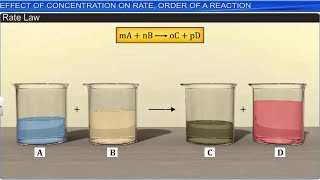



Unlock 4 Learning Videos
Sign up free to access all content, practice PYQs, and get AI explanations.
NEET PYQs — Chemical Kinetics
44 Sign up to accessShowing 3 of 44 questions. Sign up to practice all with answers, explanations, and AI help.
For a certain reaction R → Product, the plot of concentration [R] versus time has a negative slope as shown. The order of reaction is:
Given the expression for the rate constant of a first-order reaction at temperature T(K): ln k = 14.34 − (1.25 × 10⁴)/T. The energy of activation in kcal mol⁻¹ is: (Given: k in s⁻¹, R = 1.987 cal mol⁻¹ K⁻¹)
Match List I with List II: Choose the correct answer from the options given below :
Unlock the full Chemical Kinetics experience
All diagrams, videos, quick revision, PYQ practice with AI explanations — plus mock tests, flashcards, and a personalised study plan.