
Equilibrium Notes
Study Notes
Topics
10Physical Equilibrium
Overview
Physical equilibrium occurs when two physical states or processes coexist with no observable macroscopic change, although microscopic changes continue. In a closed system, evaporation and condensation, melting and freezing, or sublimation and deposition can occur at equal rates. This dynamic nature is central to NCERT and NEET questions. Examples include ice and water at 273 K, saturated salt solution, water vapour in a closed container, and iodine crystals with iodine vapour. Important measurable ideas are vapour pressure, saturation, phase boundaries, and the effect of temperature and pressure. Physical equilibrium helps students understand why equilibrium does not mean stopping, but equal opposing rates.
- 1Physical equilibrium involves no chemical composition change.
- 2Saturated solution represents solute-solid equilibrium with dissolved solute.
- 3Boiling occurs when vapour pressure equals external pressure.
- 4Phase diagrams show stable regions of solid, liquid, and gas.
- 5Dynamic equilibrium is established faster when surface area or temperature is higher.
- 6For pure substances, equilibrium conditions are fixed at a given pressure and temperature.
Dynamic Means Doing
Remember: equilibrium is not dead still. It is a busy balance where both opposite processes keep doing work at equal rates.
Closed Container Rule
For liquid-vapour equilibrium, think 'cap it to trap it' because escaping vapour prevents equilibrium in an open vessel.
Water Bottle Example
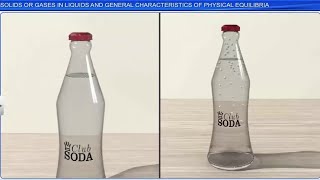
In a closed water bottle, some water evaporates and some vapour condenses. After some time, the level appears unchanged because both rates become equal.
Saturated Sugar Solution
Undissolved sugar and dissolved sugar remain in equilibrium when dissolution and crystallization occur at equal rates.
Thinking Equilibrium Means No Motion
At equilibrium, molecules still move and processes continue. Only the rates and macroscopic properties become constant.
Confusing Evaporation with Boiling
Evaporation can occur at any temperature, while boiling requires vapour pressure to equal external pressure.
A liquid boils when its vapour pressure becomes equal to the external pressure.
Variables
P_vapour=Vapour pressure of the liquid
P_external=External atmospheric or applied pressure
Chemical Equilibrium and Law of Mass Action
Overview
Chemical equilibrium is reached in a reversible reaction when the rate of forward reaction becomes equal to the rate of backward reaction. Reactants and products continue to interconvert, but their concentrations become constant with time. According to the law of mass action, the rate of a chemical reaction is proportional to the product of active masses of reactants raised to their stoichiometric powers. For a general reaction, this leads to the equilibrium constant expression. NEET frequently tests writing Kc correctly, excluding pure solids and liquids, interpreting equilibrium composition, and understanding that equilibrium can be reached from either direction in a closed system.
- 1Equilibrium is dynamic and molecular collisions continue.
- 2Law of mass action connects concentration and reaction rate.
- 3Stoichiometric coefficients become powers in Kc expression.
- 4The value of K depends only on temperature for a given reaction.
- 5Large K means product-favoured equilibrium; small K means reactant-favoured equilibrium.
- 6Chemical equilibrium requires a closed system for gases and volatile substances.
Products on Top
For Kc, always place products in numerator and reactants in denominator: P over R.
Solid-Liquid Silent
Pure solids and pure liquids are silent in K expressions because their active masses are constant.
Haber Process
N2 + 3H2 ⇌ 2NH3 is a classic reversible reaction where ammonia formation and decomposition occur simultaneously at equilibrium.
Dissociation of PCl5
PCl5 ⇌ PCl3 + Cl2 is frequently used in NEET to calculate Kc, Kp, and degree of dissociation.
Using Initial Concentrations in Kc
Kc must be calculated using equilibrium concentrations, not initial concentrations.
Assuming Equal Concentrations
Equilibrium means equal rates, not equal amounts of reactants and products.
Gives concentration-based equilibrium constant for a homogeneous reaction.
Variables
[A], [B], [C], [D]=Equilibrium molar concentrations
a, b, c, d=Stoichiometric coefficients
Equilibrium Constant Kc, Kp and Reaction Quotient
Overview
The equilibrium constant measures how far a reversible reaction proceeds before equilibrium is established. Kc uses molar concentrations, while Kp uses partial pressures for gaseous reactions. Their relation depends on the change in moles of gaseous species, Δn. The reaction quotient Q has the same expression as K but uses concentrations or pressures at any instant, not necessarily equilibrium. Comparing Q with K predicts the direction of reaction. This topic is very important for NEET numerical problems involving ICE tables, partial pressure, degree of dissociation, and deciding whether a reaction moves forward or backward.
- 1Kc and Kp are dimensionless in modern thermodynamics, though units may appear in older numerical treatment.
- 2Only gaseous species enter Kp expression.
- 3ICE tables help organize initial, change, and equilibrium amounts.
- 4For reverse reaction, K_reverse = 1 / K_forward.
- 5If a reaction is multiplied by n, new K = K^n.
- 6If reactions are added, total K is product of individual K values.
Q is Question, K is Known Answer
Compare the current question Q with the equilibrium answer K to decide which direction the reaction must move.
Delta n is Gas Only
For Kp = Kc(RT)^Δn, count only gaseous moles. Ignore solids, liquids, and aqueous species.
PCl5 Dissociation
For PCl5(g) ⇌ PCl3(g) + Cl2(g), Δn = 2 - 1 = 1, so Kp = KcRT.
No Change Case
For H2(g) + I2(g) ⇌ 2HI(g), Δn = 0, so Kp = Kc.
Counting All Species in Δn
Δn includes only gaseous species. Including solids or liquids gives wrong Kp-Kc relation.
Reversing Q Direction
If Q is less than K, products are deficient, so the reaction goes forward.
Relates pressure equilibrium constant to concentration equilibrium constant for gaseous reactions.
Variables
Kp=Equilibrium constant in terms of partial pressure
Kc=Equilibrium constant in terms of molar concentration
R=Gas constant
T=Absolute temperature in kelvin
Δn=Moles of gaseous products minus gaseous reactants
Same form as Kc but calculated at any instant to predict reaction direction.
Variables
Qc=Reaction quotient using concentration
[A], [B], [C], [D]=Instantaneous molar concentrations
Le Chatelier Principle and Factors Affecting Equilibrium
Overview
Le Chatelier principle states that when a system at equilibrium is disturbed by changing concentration, pressure, volume, or temperature, the system shifts in a direction that reduces the disturbance. It is a prediction tool for equilibrium shifts and industrial optimization. Adding reactant usually shifts equilibrium forward; increasing pressure favours the side with fewer gaseous moles; increasing temperature favours the endothermic direction. A catalyst does not shift equilibrium; it only helps equilibrium reach faster by lowering activation energy of both directions equally. NEET commonly asks conceptual questions on Haber process, Contact process, colour changes, and pressure-volume effects.
- 1Le Chatelier principle predicts direction, not exact equilibrium composition.
- 2Pressure affects only gaseous equilibria with unequal gaseous moles.
- 3If Δn_gas = 0, pressure or volume change has no shift effect.
- 4Temperature changes can change the numerical value of K.
- 5Catalyst lowers activation energy for both forward and reverse reactions equally.
- 6Industrial processes use compromise conditions for yield and rate.
Equilibrium Pushes Back
Le Chatelier is like a spring: push the system, and it pushes back to reduce the effect.
Heat as a Species
Write heat on product side for exothermic and reactant side for endothermic reactions to predict temperature shifts.
Haber Process
N2 + 3H2 ⇌ 2NH3 has fewer gas moles on product side, so high pressure favours ammonia formation.
Brown NO2 Equilibrium
2NO2 ⇌ N2O4 is exothermic in forward direction. Cooling favours colourless N2O4, while heating favours brown NO2.
Saying Catalyst Increases Yield
Catalyst increases rate of reaching equilibrium, not equilibrium yield.
Applying Pressure Rule to Liquids
Pressure-volume shifts are significant mainly for gaseous equilibria.
Heat behaves like a product in exothermic reactions, so adding heat shifts equilibrium backward.
Variables
T=Absolute temperature
K=Equilibrium constant
Ionic Equilibrium, Electrolytes and Ostwald Dilution Law
Overview
Ionic equilibrium deals with reversible ionization of weak electrolytes in aqueous solution. Strong electrolytes almost completely ionize, while weak electrolytes partially ionize and establish equilibrium between unionized molecules and ions. Degree of ionization, α, represents the fraction ionized and depends on concentration, dilution, temperature, and common ions. Ostwald dilution law relates the dissociation constant of a weak electrolyte with concentration and α. Dilution increases ionization of weak electrolytes, while addition of a common ion suppresses ionization. These concepts form the base for pH, buffers, salt hydrolysis, and solubility product problems in NEET.
- 1Ionic equilibrium applies to aqueous weak electrolytes.
- 2For weak acid HA, Ka = Cα²/(1-α).
- 3If α is very small, Ka ≈ Cα².
- 4Common ion effect is a direct application of Le Chatelier principle.
- 5Ionization increases as concentration decreases.
- 6The dissociation constant depends on temperature.
Dilution Dissociates
For weak electrolytes, remember D-D: Dilution increases Dissociation.
Common Ion Compresses Ionization
A common ion is like crowding the product side, so the equilibrium shifts back.
Acetic Acid Dilution
When CH3COOH is diluted, its percent ionization increases because the equilibrium shifts toward more ions.
Adding Sodium Acetate
Adding CH3COONa to CH3COOH supplies CH3COO- and suppresses acetic acid ionization.
Applying Ostwald Law to Strong Electrolytes
Ostwald dilution law is meant for weak electrolytes, not strong acids or salts that ionize almost completely.
Forgetting Approximation Condition
Use 1 - α ≈ 1 only when α is very small, generally less than about 0.05.
Fraction of electrolyte molecules that dissociate into ions.
Variables
α=Degree of ionization or dissociation
Relates acid dissociation constant to concentration and degree of ionization.
Variables
Ka=Acid dissociation constant
C=Initial molar concentration
α=Degree of ionization
Acids, Bases, pH, pKa and pKb
Overview
Acids and bases can be understood through Arrhenius, Bronsted-Lowry, and Lewis concepts. Arrhenius acids produce H+ in water and bases produce OH-. Bronsted acids donate protons, while Bronsted bases accept protons. Lewis acids accept electron pairs and Lewis bases donate electron pairs, making this the broadest concept. pH measures hydrogen ion concentration and is crucial for NEET numericals. Strong acids and bases ionize almost completely, whereas weak acids and bases require Ka or Kb. pKa and pKb are logarithmic strength indicators: smaller pKa means stronger acid, and smaller pKb means stronger base.
- 1Lewis theory includes reactions without proton transfer.
- 2Water is amphoteric because it can donate or accept H+.
- 3Strong acid pH is calculated directly from concentration if fully ionized.
- 4Weak acid pH requires Ka and approximation or quadratic solution.
- 5pH scale is logarithmic: one unit change means tenfold change in [H+].
- 6At 298 K, neutral solution has pH = 7 because [H+] = [OH-] = 10^-7 M.
BL: Base Likes H+
In Bronsted-Lowry theory, a base likes and accepts H+, while acid donates H+.
Lewis Lends Pair
Lewis base lends an electron pair; Lewis acid accepts it.
pH Power
Each pH unit is a power of 10 change in hydrogen ion concentration.
Strong Acid pH
For 0.01 M HCl, [H+] = 10^-2 M, so pH = 2.
Lewis Acid Example
BF3 acts as a Lewis acid because boron has an incomplete octet and accepts an electron pair from NH3.
Forgetting Logarithmic Scale
pH 3 is ten times more acidic than pH 4, not just one unit more acidic.
Using pH + pOH = 14 at All Temperatures
pH + pOH = 14 strictly applies at 298 K because Kw changes with temperature.
Measures acidity of a solution using hydrogen ion concentration.
Variables
pH=Negative logarithm of hydrogen ion concentration
[H+]=Molar concentration of hydrogen ions
Measures basicity using hydroxide ion concentration.
Variables
pOH=Negative logarithm of hydroxide ion concentration
[OH-]=Molar concentration of hydroxide ions
At 298 K, Kw = 1.0 × 10^-14.
Variables
Kw=Ionic product of water
[H+]=Hydrogen ion concentration
[OH-]=Hydroxide ion concentration
Hydrolysis of Salts and pH of Salt Solutions
Overview
Salt hydrolysis occurs when ions of a salt react with water to produce H+ or OH-, making the solution acidic or basic. Salts of strong acid and strong base do not hydrolyse appreciably and give neutral solution. Salts of strong acid and weak base produce acidic solutions because the cation hydrolyses. Salts of weak acid and strong base produce basic solutions because the anion hydrolyses. Salts of weak acid and weak base require comparison of Ka and Kb. NEET often asks direct pH nature, hydrolysis constant, and relation between hydrolysis and conjugate acid-base strength.
- 1Hydrolysis is reverse of neutralization for salt ions.
- 2Conjugate base of weak acid is basic and hydrolyses.
- 3Conjugate acid of weak base is acidic and hydrolyses.
- 4NaCl solution is neutral because Na+ and Cl- do not hydrolyse significantly.
- 5NH4Cl solution is acidic due to NH4+ hydrolysis.
- 6CH3COONa solution is basic due to acetate ion hydrolysis.
Strong Parents, Neutral Child
A salt from strong acid and strong base is neutral because both parent ions are too weak to hydrolyse.
Weak Acid Salt is Basic
If the acid parent is weak, its conjugate base is strong enough to take H+ from water, giving OH-.
NH4Cl is Acidic
NH4+ donates H+ to water to form H3O+, so ammonium chloride solution has pH less than 7.
Sodium Acetate is Basic
CH3COO- accepts H+ from water, leaving OH-, so sodium acetate solution has pH greater than 7.
Calling Every Salt Neutral
Only salts of strong acid and strong base are neutral. Many salts hydrolyse and change pH.
Ignoring Ka versus Kb for Weak-Weak Salts
For weak acid-weak base salts, compare Ka and Kb to decide acidic, basic, or neutral nature.
Used for anion hydrolysis such as CH3COO- in sodium acetate.
Variables
Kh=Hydrolysis constant
Kw=Ionic product of water
Ka=Dissociation constant of weak acid
Used for cation hydrolysis such as NH4+ in ammonium chloride.
Variables
Kh=Hydrolysis constant
Kw=Ionic product of water
Kb=Dissociation constant of weak base
Buffer Solutions and Henderson Equation
Overview
A buffer solution resists change in pH when small amounts of acid or base are added. Acidic buffers contain a weak acid and its salt with a strong base, such as CH3COOH and CH3COONa. Basic buffers contain a weak base and its salt with a strong acid, such as NH4OH and NH4Cl. Buffer action occurs due to the common ion effect: added H+ or OH- is consumed by buffer components. Henderson-Hasselbalch equations allow quick pH calculation. Buffers are important in biological systems like blood, in analytical chemistry, and in NEET problems involving pKa, pKb, and concentration ratios.
- 1Buffers resist pH change but do not keep pH absolutely constant under unlimited acid or base.
- 2The salt supplies conjugate ion needed to neutralize added acid or base.
- 3Dilution changes buffer capacity but pH changes only slightly if ratio remains same.
- 4Blood buffer mainly involves carbonic acid and bicarbonate ions.
- 5Henderson equation uses concentration ratio, so units cancel.
- 6A good buffer has pKa close to desired pH.
Buffer Has Both Shield and Sponge
The weak acid/base pair acts like a shield: one part absorbs H+, the other absorbs OH-.
Salt Over Acid
For acidic buffer, remember pH has salt over acid: pH = pKa + log S/A.
Acetate Buffer
A mixture of CH3COOH and CH3COONa maintains pH near the pKa of acetic acid.
Blood Buffer
The H2CO3/HCO3- system helps maintain blood pH around 7.4.
Using Strong Acid and Strong Base as Buffer
A buffer needs a weak acid/base and its conjugate salt. Strong acid-base mixtures do not provide buffer action.
Forgetting pOH in Basic Buffer
For basic buffer, first calculate pOH, then convert using pH = 14 - pOH at 298 K.
Calculates pH of weak acid and conjugate base buffer.
Variables
pH=Acidity measure of buffer
pKa=Negative logarithm of acid dissociation constant
[salt]=Concentration of conjugate base salt
[acid]=Concentration of weak acid
Solubility Product, Precipitation and Common Ion Effect
Overview
Solubility product, Ksp, is the equilibrium constant for dissolution of a sparingly soluble salt in water. When a salt such as AgCl dissolves, a dynamic equilibrium exists between solid salt and its ions in solution. The ionic product is calculated using actual ion concentrations at any instant. If ionic product is less than Ksp, no precipitate forms; if equal, the solution is saturated; if greater, precipitation occurs. Common ion effect decreases solubility by shifting dissolution equilibrium backward. This topic is highly important for NEET problems on precipitation, salt solubility, group separation, and comparing Ksp values.
- 1Ksp is a constant at a given temperature.
- 2Molar solubility must be converted using stoichiometry before writing Ksp.
- 3For AB salt, Ksp = s² if solubility is s.
- 4For AB2 salt, Ksp = 4s³.
- 5Selective precipitation depends on different Ksp values.
- 6Adding a common ion shifts equilibrium toward undissolved solid.
Qsp Decides Precipitate
Think of Qsp as current ion crowding. If crowding exceeds Ksp capacity, the salt precipitates.
Common Ion Crashes Solubility
Adding an ion already present pushes the dissolved salt back into solid form.
AgCl Precipitation
Mixing AgNO3 and NaCl gives Ag+ and Cl-. If [Ag+][Cl-] exceeds Ksp of AgCl, a white precipitate forms.
Group Analysis
Selective precipitation of metal ions is based on differences in Ksp values of their salts.
Comparing Ksp Without Stoichiometry
You can directly compare solubility using Ksp only for salts with the same ion ratio.
Forgetting Powers in Ksp
For AB2, [B-] = 2s, so Ksp = s(2s)^2 = 4s^3, not s^3.
Used when one mole of salt gives one cation and one anion.
Variables
Ksp=Solubility product constant
s=Molar solubility of AB
Stoichiometry must be included when ions are produced in unequal numbers.
Variables
Ksp=Solubility product constant
s=Molar solubility of AB2
Formula Sheet, Quick Revision and NEET Mind Map
Overview
This topic collects the most exam-oriented formulas, decision rules, and NCERT concepts from the complete Equilibrium chapter. For NEET, students must rapidly connect physical equilibrium, chemical equilibrium, Le Chatelier principle, ionic equilibrium, pH calculations, buffer equations, hydrolysis, and solubility product. Most errors occur when students use initial concentration instead of equilibrium concentration, include solids in K expressions, forget Δn is only for gases, or apply pH formulas outside their conditions. The mind map helps revise the chapter as one connected system: equilibrium constants describe position, Q predicts direction, Le Chatelier predicts shift, and ionic equilibria explain pH, buffers, and precipitation.
- 1Pure solids and liquids are excluded from K, Q, and Ksp expressions.
- 2K changes only with temperature, not with catalyst or concentration.
- 3Strong electrolytes ionize almost completely; weak electrolytes use equilibrium constants.
- 4Common ion effect suppresses ionization and solubility.
- 5For salt hydrolysis, identify parent acid and base first.
- 6For buffer problems, identify whether pH or pOH equation is needed.
K-Q-L-pH-Ksp Chain
Remember the chapter flow as K tells position, Q tells direction, Le Chatelier tells shift, pH tells acidity, and Ksp tells precipitation.
Products Over Reactants
Most equilibrium expressions begin with the same habit: products on top, reactants below, powers from coefficients.
Fast Direction Check
If for a reaction K = 10 and Q = 2, products are deficient, so the reaction proceeds forward.
Fast Buffer Check
If [salt] = [acid] in an acidic buffer, pH = pKa because log 1 = 0.
Fast Ksp Check
If Ksp of AgCl is 1.8 × 10^-10 and [Ag+][Cl-] is 10^-8, precipitation occurs because Qsp > Ksp.
Mixing K and Q
K is only at equilibrium; Q is at any instant. Use Q for direction prediction.
Not Checking Approximation
Weak acid/base approximations should be verified when ionization is not very small.
Forgetting Temperature Dependence
Only temperature changes the equilibrium constant. Concentration and pressure change position but not K.
Universal structure for concentration equilibrium constant.
Variables
Kc=Concentration equilibrium constant
Use only for gaseous reactions.
Variables
Δn=Gaseous product moles minus gaseous reactant moles
Central relation for pH and pOH calculations.
Variables
Kw=Ionic product of water
Most used acid-base formulas in NEET.
Variables
[H+]=Hydrogen ion concentration
[OH-]=Hydroxide ion concentration
Formula Sheet
10A liquid boils when its vapour pressure becomes equal to the external pressure.
Variables
P_vapour=Vapour pressure of the liquid
P_external=External atmospheric or applied pressure
Used to compare actual water vapour present in air with the maximum possible vapour at that temperature.
Variables
actual vapour pressure=Partial pressure of water vapour present
saturated vapour pressure=Maximum vapour pressure of water at same temperature
Gives concentration-based equilibrium constant for a homogeneous reaction.
Variables
[A], [B], [C], [D]=Equilibrium molar concentrations
a, b, c, d=Stoichiometric coefficients
According to mass action for an elementary forward reaction, rate depends on active masses of reactants.
Variables
r_f=Forward reaction rate
[A], [B]=Active masses or molar concentrations
Relates pressure equilibrium constant to concentration equilibrium constant for gaseous reactions.
Variables
Kp=Equilibrium constant in terms of partial pressure
Kc=Equilibrium constant in terms of molar concentration
R=Gas constant
T=Absolute temperature in kelvin
Δn=Moles of gaseous products minus gaseous reactants
5 more formulas locked
Sign up free to access all formulas with variables and explanations.
Quick Revision
12 Sign up to accessUnlock 12 Quick Revision Points
Sign up free to access all content, practice PYQs, and get AI explanations.
Learning Videos
6 Sign up to access



Unlock 6 Learning Videos
Sign up free to access all content, practice PYQs, and get AI explanations.
NEET PYQs — Equilibrium
52 Sign up to accessShowing 3 of 52 questions. Sign up to practice all with answers, explanations, and AI help.
At 298 K, a certain buffer solution contains equal concentrations of X⁻ and HX. K$_b$ for X⁻ is 10⁻¹⁰. What is the pH of this buffer solution?
Phenolphthalein is used as an indicator for the titration of sodium hydroxide solution against a standard solution of oxalic acid. The colour change observed at alkaline pH close to the equivalence point is:
Given below are certain reactions. Identify the reaction for which Kp ≠ Kc.
Unlock the full Equilibrium experience
All diagrams, videos, quick revision, PYQ practice with AI explanations — plus mock tests, flashcards, and a personalised study plan.