
Alcohols, Phenols and Ethers Notes
Study Notes
Topics
4📖 1. Chapter Overview
Overview
Alcohols, phenols and ethers are oxygen-containing organic compounds formed by replacing hydrogen of hydrocarbons with oxygen-based functional groups. Alcohols contain an -OH group attached to an sp3 carbon, phenols contain -OH directly attached to an aromatic ring, and ethers contain an oxygen atom between two carbon groups. Their properties depend strongly on hydrogen bonding, polarity, resonance, inductive effects and steric factors. NEET questions commonly test nomenclature, preparation methods, acidity order, reaction mechanisms, Lucas test, oxidation, dehydration, Williamson synthesis, cleavage of ethers and named reactions such as Reimer-Tiemann and Kolbe reactions. This chapter connects structure with reactivity and has high scoring conceptual patterns.
- 1Functional group position and hybridisation decide classification and reactivity.
- 2Hydrogen bonding raises boiling points of alcohols and phenols compared with ethers and hydrocarbons.
- 3Phenol is acidic but weaker than carboxylic acids and stronger than alcohols.
- 4Oxidation of alcohols helps identify 1°, 2° and 3° alcohols.
- 5Ethers are relatively inert but cleaved by strong hydrogen halides.
- 6Aromatic -OH activates benzene ring strongly toward electrophilic substitution.
- 7Industrial importance includes ethanol, methanol, phenol, anisole and diethyl ether.
A-P-E Chapter Order
A-P-E means Alcohols, Phenols, Ethers: first learn -OH on alkyl, then -OH on aryl, then oxygen bridge.
Phenol Acid Clue
Phenol forms phenoxide; remember 'oxide spreads' because negative charge spreads by resonance.
Daily Life Connections
Ethanol is present in sanitizers, phenol derivatives are used in antiseptics, and ethers are used as solvents and in older anaesthetic practice.
NEET Pattern Example
If asked to compare acidity of ethanol, phenol and water, use conjugate base stability: phenol is most acidic due to resonance-stabilized phenoxide ion.
Confusing Phenol with Alcohol
Phenol is not an aromatic alcohol in reaction behavior because -OH is directly attached to an sp2 aromatic carbon.
Assuming Ethers Hydrogen Bond with Themselves
Ethers can accept hydrogen bonds from water but cannot form intermolecular hydrogen bonds among themselves because they lack O-H hydrogen.
Acyclic saturated monohydric alcohols and simple ethers are functional isomers having the same molecular formula.
Variables
n=Number of carbon atoms
Phenols contain hydroxyl group directly bonded to an aromatic ring.
Variables
Ar=Aryl group such as phenyl, C6H5-
OH=Hydroxyl group attached to aromatic carbon
🍶 2. Alcohols
Overview
Alcohols are compounds in which one or more hydroxyl groups are attached to saturated carbon atoms. They are classified as monohydric, dihydric or trihydric based on number of -OH groups and as primary, secondary or tertiary based on the carbon bearing -OH. NCERT emphasizes IUPAC nomenclature, preparation by hydrolysis of alkyl halides, hydration of alkenes, reduction of aldehydes, ketones, acids and esters, and Grignard reagent reactions. Their physical properties arise from polarity and hydrogen bonding. Important reactions include cleavage of O-H bond, cleavage of C-O bond, esterification, oxidation, dehydration, substitution with HX and tests such as Lucas test. Methanol and ethanol are commercially important and frequently appear in NEET.
- 1Alcohols show reactions due to both O-H bond and C-O bond.
- 2Acidic strength of alcohols is affected by electron-donating alkyl groups; more alkyl substitution generally decreases acidity.
- 3Reaction with sodium gives hydrogen gas and sodium alkoxide.
- 4Esterification with carboxylic acids is reversible and acid catalysed.
- 5Primary alcohols can be selectively oxidized to aldehydes using PCC.
- 6Concentrated H2SO4 causes dehydration to alkenes at higher temperature.
- 7Methanol is highly poisonous; ethanol is the alcohol in beverages and sanitizers.
Oxidation Order
Remember '1 goes further, 2 stops in middle, 3 refuses': primary alcohol oxidizes to aldehyde then acid, secondary to ketone, tertiary resists.
Lucas Test
Lucas loves stable carbocations: 3° cloudy instantly, 2° slowly, 1° hardly at room temperature.
Solubility
Small alcohols are water-friendly; big alkyl chains are water-shy.
Nomenclature Example
CH3-CH(OH)-CH3 is propan-2-ol, a secondary alcohol because the -OH carbon is attached to two carbon atoms.
Reaction Example
Ethanol reacts with sodium to form sodium ethoxide and hydrogen gas: 2C2H5OH + 2Na → 2C2H5ONa + H2.
Preparation Example
Ethanal on reduction with NaBH4 gives ethanol, while propanone gives propan-2-ol.
Wrong IUPAC Numbering
Give the hydroxyl group the lowest possible locant because -OH is the principal functional group in alcohol nomenclature.
Overoxidation Confusion
Strong oxidants convert primary alcohols to acids, but PCC can stop oxidation at aldehyde.
Assuming Tertiary Alcohol Oxidizes Easily
Tertiary alcohols lack alpha hydrogen on the carbinol carbon, so they resist normal oxidation.
Ignoring Rearrangement
Acid-catalysed reactions involving carbocations may undergo rearrangement if a more stable carbocation can form.
Represents acyclic saturated alcohols with one hydroxyl group.
Variables
n=Number of carbon atoms in alkyl group plus hydroxyl-bearing chain
Alcohols behave as very weak acids and produce hydrogen gas with sodium metal.
Variables
R=Alkyl group
RONa=Sodium alkoxide
🌿 3. Phenols
Overview
Phenols contain a hydroxyl group directly attached to an aromatic ring, so their chemistry is different from alcohols. The C-O bond in phenol has partial double bond character because the oxygen lone pair participates in resonance with the benzene ring. Phenols are prepared from haloarenes, benzene sulfonic acid, diazonium salts and industrially from cumene. They show hydrogen bonding and have higher boiling points than hydrocarbons of similar mass. Their most important property for NEET is acidic nature: phenoxide ion is resonance stabilized, making phenols more acidic than alcohols. Phenol also activates the ring and directs electrophiles to ortho and para positions, giving characteristic reactions such as bromination, nitration, Kolbe and Reimer-Tiemann reactions.
- 1Phenol has partial double bond character in C-O bond due to resonance.
- 2Phenoxide ion has delocalized negative charge over oxygen and ring carbons.
- 3Phenol reacts with NaOH but alcohols generally do not.
- 4Phenol does not react with NaHCO3 because it is weaker than carbonic acid.
- 5Nitration conditions decide product: dilute nitric acid gives o- and p-nitrophenol; concentrated nitric acid gives picric acid.
- 6Ortho-nitrophenol is steam volatile due to intramolecular hydrogen bonding, while para-nitrophenol has intermolecular hydrogen bonding.
- 7Phenol is used in antiseptics, plastics, dyes, drugs and resins.
Ortho-Para Director
Phenol says 'OH! come Ortho or Para' because -OH activates the ring and directs incoming electrophiles to ortho and para positions.
Kolbe vs Reimer
Kolbe adds COOH, Reimer adds CHO: K for carboxylate carbon dioxide, R for aldehyde ring formylation.
Phenol Acidity
Phenoxide is 'phenomenally stable' by resonance, so phenol is more acidic than alcohol.
Acidity Example
Phenol dissolves in NaOH to form sodium phenoxide, but ethanol does not react significantly with NaOH.
Test Example
A white precipitate with bromine water indicates phenol due to formation of 2,4,6-tribromophenol.
PYQ Concept Example
If asked to rank phenol, p-nitrophenol and p-cresol by acidity: p-nitrophenol > phenol > p-cresol.
Reacting Phenol with NaHCO3
Phenol is not acidic enough to liberate CO2 from sodium bicarbonate; carboxylic acids do.
Ignoring Substituent Position
Ortho and para nitro groups stabilize phenoxide by resonance more effectively than meta nitro group.
Wrong Product in Bromine Water
Phenol with bromine water gives 2,4,6-tribromophenol, not only mono-bromophenol, because the ring is highly activated.
Confusing Ortho and Para Nitrophenol Boiling Behavior
Ortho-nitrophenol has intramolecular hydrogen bonding and is steam volatile; para-nitrophenol has intermolecular hydrogen bonding and higher boiling point.
Phenol donates proton to form resonance-stabilized phenoxide ion.
Variables
C6H5OH=Phenol
C6H5O−=Phenoxide ion
H+=Proton released
Sodium phenoxide reacts with carbon dioxide under pressure followed by acidification to form salicylic acid.
Variables
C6H5ONa=Sodium phenoxide
CO2=Carbon dioxide electrophile
o-HOC6H4COOH=Salicylic acid
⚗️ 4. Ethers
Overview
Ethers contain an oxygen atom bonded to two alkyl or aryl groups and are represented as R-O-R′. They may be symmetrical or unsymmetrical, aliphatic, aromatic or mixed ethers. In IUPAC nomenclature, the smaller alkyl group with oxygen is treated as an alkoxy substituent. Ethers are polar but cannot form intermolecular hydrogen bonds with themselves, so their boiling points are lower than isomeric alcohols. They are prepared by dehydration of alcohols and by Williamson ether synthesis, an important SN2 reaction between alkoxide and primary alkyl halide. Ethers are generally less reactive, but undergo cleavage with HI or HBr. Aromatic ethers such as anisole undergo electrophilic substitution at ortho and para positions.
- 1Ether oxygen is sp3 hybridized and the C-O-C angle is slightly greater than tetrahedral due to repulsion.
- 2Ethers are good organic solvents because they dissolve many organic compounds and are relatively inert.
- 3Acidic cleavage begins by protonation of ether oxygen.
- 4In cleavage of unsymmetrical ethers with HI, the halide attacks the less hindered alkyl group unless a stable tertiary carbocation can form.
- 5Aryl-alkyl ethers such as anisole give phenol and alkyl iodide with HI because aryl C-O bond has partial double bond character.
- 6Williamson synthesis is an SN2 reaction and works best with primary substrates.
- 7Diethyl ether is volatile and highly inflammable.
Williamson Rule
Williamson wants 'small halide side': put the primary or methyl group as alkyl halide and the bulky side as alkoxide.
Ether Cleavage
HI says 'I attack alkyl, not aryl'; aryl-alkyl ethers give phenol and alkyl iodide.
Ether Boiling Point
Ether oxygen has lone pairs but no O-H hand to hold another ether, so boiling point stays lower than alcohol.
Nomenclature Example
CH3OCH2CH3 is methoxyethane in IUPAC and ethyl methyl ether in common nomenclature.
Williamson Example
Sodium ethoxide reacts with methyl iodide to give methoxyethane: C2H5ONa + CH3I → C2H5OCH3 + NaI.
Cleavage Example
Anisole on heating with HI forms phenol and methyl iodide, not iodobenzene.
Using Tertiary Alkyl Halide in Williamson Synthesis
Tertiary halides undergo elimination with alkoxide instead of SN2 ether formation.
Breaking Aryl-O Bond in Anisole
Aryl-O bond has partial double bond character and does not break easily; cleavage occurs at alkyl-O bond.
Naming by Common Name Only
For IUPAC, name ethers as alkoxyalkanes by choosing the longer carbon chain as parent.
Assuming Ethers Are Completely Nonpolar
Ethers are polar due to C-O bonds and bent geometry, but they lack self hydrogen bonding.
Oxygen is bonded to two alkyl or aryl groups.
Variables
R, R′=Alkyl or aryl groups
O=Ether oxygen atom
Sodium alkoxide reacts with alkyl halide to form ether by SN2 mechanism.
Variables
RONa=Sodium alkoxide
R′X=Alkyl halide, preferably primary
ROR′=Ether product
⚡ 5. Reactions & Important Applications
Overview
This topic collects the highest-yield reactions and applications of alcohols, phenols and ethers for NEET revision. Alcohols mainly undergo oxidation, dehydration, esterification and substitution; phenols undergo acidic reactions and electrophilic substitution; ethers undergo Williamson synthesis and cleavage by hydrogen halides. Named reactions such as Williamson ether synthesis, Kolbe reaction, Reimer-Tiemann reaction and Lucas test are repeatedly tested because they connect mechanism with product prediction. Comparative reactivity depends on carbocation stability, resonance stabilization, hydrogen bonding, steric hindrance and bond strength. Applications are also important: methanol and ethanol are fuels and solvents, phenol is used in antiseptics and resins, anisole in perfumery, and ethers as laboratory solvents.
- 1NEET product prediction often depends on choosing the correct bond that breaks or forms.
- 2SN2 reactions need less hindered substrates; carbocation reactions favor tertiary substrates.
- 3Phenoxide is more nucleophilic than phenol and is used in ether formation.
- 4Aromatic ring activation by -OH or -OR increases ortho/para substitution.
- 5Oxidation level of alcohols is a powerful identification tool.
- 6Applications are linked to properties: ethanol dissolves organics, phenol kills microbes, ethers dissolve organic reagents.
- 7Laboratory safety is important: methanol is poisonous, ether is volatile and flammable.
Named Reaction Products
Wi-Ko-Re: Williamson makes ether, Kolbe adds COOH, Reimer adds CHO.
Alcohol Reaction Priority
For alcohols, ask three questions: Can it oxidize? Can it form carbocation? Can it lose water?
Applications Memory
Ethanol cleans, phenol kills, ether dissolves: sanitizer, antiseptic and solvent.
Product Prediction
When tert-butanol is treated with Lucas reagent, immediate turbidity appears because tert-butyl chloride forms rapidly.
Named Reaction Example
Sodium phenoxide treated with CO2 under pressure followed by acidification gives salicylic acid, an important precursor of aspirin.
Application Example
Diethyl ether is used as a solvent for Grignard reagents because it is relatively inert and stabilizes the reagent through oxygen lone pairs.
NEET Mixed Concept Example
If CH3OC(CH3)3 reacts with HI, products include CH3OH and tert-butyl iodide because the tertiary carbocation pathway is favored.
Memorising Products Without Conditions
Phenol with dilute nitric acid gives o- and p-nitrophenol; concentrated nitric acid gives picric acid. Conditions change products.
Ignoring Mechanism Type
Williamson is SN2, so steric hindrance matters. Lucas test involves carbocation tendency, so tertiary reacts fastest.
Mixing Up Salicylic Acid and Salicylaldehyde
Kolbe gives salicylic acid, Reimer-Tiemann gives salicylaldehyde.
Assuming All Oxygen Compounds Are Equally Acidic
Acidity depends on conjugate base stability: carboxylate > phenoxide > alkoxide.
A strong nucleophile alkoxide attacks a primary alkyl halide to form an ether.
Variables
R-O−=Alkoxide ion
R′-X=Alkyl halide
R-O-R′=Ether
Oxidation products identify alcohol class.
Variables
RCHO=Aldehyde
RCOOH=Carboxylic acid
RCOR′=Ketone
Formula Sheet
10Acyclic saturated monohydric alcohols and simple ethers are functional isomers having the same molecular formula.
Variables
n=Number of carbon atoms
Phenols contain hydroxyl group directly bonded to an aromatic ring.
Variables
Ar=Aryl group such as phenyl, C6H5-
OH=Hydroxyl group attached to aromatic carbon
Ethers contain an oxygen atom bonded to two alkyl or aryl groups.
Variables
R, R′=Alkyl or aryl groups, same or different
O=Ether oxygen
Represents acyclic saturated alcohols with one hydroxyl group.
Variables
n=Number of carbon atoms in alkyl group plus hydroxyl-bearing chain
Alcohols behave as very weak acids and produce hydrogen gas with sodium metal.
Variables
R=Alkyl group
RONa=Sodium alkoxide
5 more formulas locked
Sign up free to access all formulas with variables and explanations.
Quick Revision
12 Sign up to accessUnlock 12 Quick Revision Points
Sign up free to access all content, practice PYQs, and get AI explanations.
Learning Videos
4 Sign up to access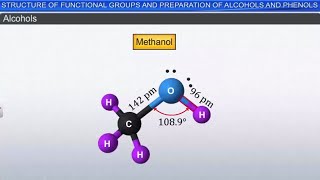


Unlock 4 Learning Videos
Sign up free to access all content, practice PYQs, and get AI explanations.
NEET PYQs — Alcohols, Phenols and Ethers
44 Sign up to accessShowing 3 of 44 questions. Sign up to practice all with answers, explanations, and AI help.
Two products X and Y are formed in the following reaction sequence. The suitable method that can be used for separation of products X and Y is:
Match List I with List II: Choose the correct answer from the options given below:
The functional group that can be identified through phthalein dye test is:
Unlock the full Alcohols, Phenols and Ethers experience
All diagrams, videos, quick revision, PYQ practice with AI explanations — plus mock tests, flashcards, and a personalised study plan.