
The d- and f-Block Elements Notes
Study Notes
Topics
5Chapter Overview
Overview
The d- and f-block elements form the central and inner transition regions of the periodic table. Their chemistry is dominated by incompletely filled d or f orbitals, variable oxidation states, coloured ions, magnetic behaviour, complex formation, catalytic activity, alloy formation and important oxidising compounds. Transition elements generally involve filling of penultimate d orbitals, while lanthanoids and actinoids involve filling of 4f and 5f orbitals. NCERT and NEET focus strongly on definitions, electronic configurations, exceptions like Cr and Cu, oxidation states of Mn and Cr, magnetic moment, lanthanoid contraction, comparison of lanthanoids and actinoids, and reactions of potassium dichromate and potassium permanganate.
- 1The chapter connects electronic configuration with properties, compounds and trends.
- 2Transition elements are hard, dense, high melting metals due to strong metallic bonding involving d electrons.
- 3Variable oxidation state, colour, magnetism and complex formation are the most asked NEET concepts.
- 4Lanthanoids mainly show +3 oxidation state; actinoids show more variable oxidation states.
- 5Potassium dichromate and potassium permanganate reactions must be remembered in acidic, basic and neutral media.
- 6Lanthanoid contraction explains similarity between 4d and 5d elements such as Zr and Hf.
- 7Most NEET questions are direct NCERT line-based plus small magnetic moment and oxidation state calculations.
Chapter Core
Remember: d/f electrons decide almost everything—oxidation state, colour, magnetism, complex formation and catalytic behaviour.
NEET Priority
For quick revision, go in this order: configuration exceptions → oxidation states → colour and magnetism → KMnO4/K2Cr2O7 → lanthanoid contraction.
Daily Life Link
Iron is used in steel, vanadium oxide is used in contact process, and platinum/palladium are used in catalytic converters because transition metals show strong catalytic and alloy-forming behaviour.
PYQ Concept
A species with unpaired d electrons is generally coloured and paramagnetic; a d10 species like Zn2+ is colourless and diamagnetic.
Calling All d-Block Elements Transition Elements
All transition elements are d-block, but all d-block elements are not typical transition elements. Zn, Cd and Hg are common exceptions.
Ignoring Medium in Redox Reactions
KMnO4 gives different products in acidic, neutral and alkaline media. Always check the medium.
Represents the general outer electronic configuration of d-block elements.
Variables
n=Principal quantum number of outermost shell
(n-1)d=Penultimate d subshell being filled
ns=Outermost s subshell
Represents lanthanoids and actinoids where f orbitals are progressively filled.
Variables
(n-2)f=Inner f subshell being filled
(n-1)d=Penultimate d subshell
ns=Outermost s subshell
Transition Elements
Overview
Transition elements are elements whose atoms or common ions contain partially filled d subshells. They occupy the central region of the periodic table, mainly groups 3 to 12. Their name reflects their position between highly electropositive s-block metals and more electronegative p-block elements. They show metallic character, high melting points, high densities, variable oxidation states, coloured ions, paramagnetism, complex formation, catalytic activity and alloy formation. These properties arise because ns and (n-1)d electrons have comparable energies and can participate in bonding. NEET frequently asks why Zn, Cd and Hg are not typical transition elements, why transition metals act as catalysts, and why they show variable oxidation states.
- 1The first transition series is Sc to Zn, second is Y to Cd, and third is La/Hf to Hg depending on classification.
- 2Partially filled d orbitals are responsible for many characteristic properties.
- 3Early transition elements show higher oxidation states more easily; later elements show lower oxidation states more commonly.
- 4Transition metals and their compounds often act as catalysts by providing surfaces and variable oxidation pathways.
- 5Many transition metals form interstitial compounds with small atoms like H, B, C and N.
- 6They form alloys because their atomic sizes are similar.
Transition Definition
Transition means 'd is not done': the d subshell is incomplete in atom or common ion.
Catalyst Reason
Transition metals catalyse because they can 'change charge and hold guests': variable oxidation states plus complex/surface adsorption.
Zn-Cd-Hg Exception
Remember 'Zinc Cadmium Mercury are d10 fully packed', so they are not typical transition elements.
PYQ Concept: Copper as Transition Element
Cu has atom configuration 3d10 4s1, but Cu2+ is 3d9. Since a common ion has incomplete d subshell, copper is a transition element.
Application: Stainless Steel
Fe, Cr and Ni form stainless steel. Similar atomic sizes and metallic bonding make transition metals excellent alloy formers.
Application: Catalytic Converter
Pt, Pd and Rh in vehicle catalytic converters help convert CO, unburnt hydrocarbons and nitrogen oxides into less harmful gases.
Confusing d-Block with Transition
Zn is a d-block element but not a typical transition element because Zn and Zn2+ have completely filled 3d10 configuration.
Assuming All Transition Elements Show Same Oxidation States
Oxidation states vary by element. Mn shows many states, while Sc mostly shows +3.
Forgetting Complex Formation in Catalysis
Catalytic activity is not only due to variable oxidation states; adsorption and complex formation are also important.
This definition explains why some d-block elements are not typical transition elements.
Variables
d subshell=Penultimate subshell containing d orbitals
common oxidation state=Stable ionic form normally shown by the element
Most d-block elements follow this general configuration, with exceptions due to extra stability.
Variables
n=Period number
(n-1)d=d subshell being filled
ns=outermost s subshell
Electronic Configuration
Overview
Electronic configuration is the foundation of d- and f-block chemistry. In d-block elements, electrons enter the penultimate (n-1)d subshell while ns electrons are also present. In f-block elements, electrons enter inner (n-2)f orbitals. Because ns and (n-1)d orbitals have close energies, d-block elements show variable oxidation states. Cr and Cu are key exceptions: chromium is [Ar] 3d5 4s1 and copper is [Ar] 3d10 4s1 due to extra stability of half-filled and fully-filled d subshells. Lanthanoids generally fill 4f orbitals and commonly form Ln3+, while actinoids fill 5f orbitals and show more variable oxidation states.
- 1Configuration exceptions must be memorised because NEET frequently asks them directly.
- 2Stability of d5 and d10 explains Cr and Cu exceptions.
- 3Transition metal ions are formed by removing ns electrons first, then d electrons.
- 4Variable oxidation states result from small energy difference between ns and (n-1)d orbitals.
- 5Lanthanoids are mainly 4f filling elements from Ce to Lu after La.
- 6Actinoids are 5f filling elements and are radioactive in general.
Cr and Cu Exception
Craves half, Cu wants full: Cr becomes d5 and Cu becomes d10.
Ion Formation
For transition metal cations, s goes first: remove ns electrons before d electrons.
Lanthanoid State
Lanthanoids love +3: most lanthanoids form Ln3+.
Solved Example: Fe2+ and Fe3+
Fe = [Ar] 3d6 4s2. Fe2+ loses two 4s electrons: [Ar] 3d6. Fe3+ loses one more 3d electron: [Ar] 3d5.
PYQ Concept: Cu+ vs Cu2+
Cu+ is 3d10 and diamagnetic, while Cu2+ is 3d9 and paramagnetic due to one unpaired electron.
Solved Example: Sc3+
Sc = [Ar] 3d1 4s2. Sc3+ loses two 4s and one 3d electron to become [Ar], so it is colourless and diamagnetic.
Removing 3d Before 4s
During ion formation, 4s electrons are removed before 3d electrons, even though 4s fills before 3d.
Writing Cr as 3d4 4s2
Chromium is [Ar] 3d5 4s1 due to half-filled d stability.
Assuming All Lanthanoids Only Show +3
+3 is most common, but Ce can show +4 and Eu/Yb can show +2 in suitable cases.
Used for transition and d-block elements.
Variables
(n-1)d=Penultimate shell d subshell
ns=Valence s subshell
Represents Sc to Zn with important exceptions like Cr and Cu.
Variables
[Ar]=Argon noble gas core
3d=d subshell being filled
4s=outer s subshell
General Properties
Overview
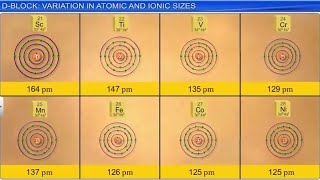
The general properties of d-block elements arise from partially filled d orbitals and strong metallic bonding. Atomic and ionic radii decrease initially across a series due to increasing nuclear charge, then become nearly constant because d-electron shielding offsets the attraction. Ionisation enthalpies generally increase across the series but show irregularities due to electronic configuration stability. Many transition metal ions are coloured because electrons absorb visible light and undergo d-d transitions. Magnetic behaviour depends on unpaired electrons; more unpaired electrons mean stronger paramagnetism. They form complexes due to small size, high charge density and vacant orbitals. They also form interstitial compounds and alloys due to suitable crystal structures and similar atomic sizes.
- 1High melting point and density are due to strong metallic bonding involving d electrons.
- 2Colour is caused by d-d transition, charge transfer or both, but NCERT NEET mainly focuses on d-d transitions.
- 3Ti4+ is d0 and Zn2+ is d10, so both are generally colourless.
- 4Fe3+ is more stable than Fe2+ in some cases due to d5 configuration.
- 5Complex formation is a hallmark of transition metals.
- 6Alloys form easily because transition metals have similar radii and can substitute each other in lattices.
- 7Interstitial compounds are hard and have high melting points but are often non-stoichiometric.
Colour Rule
d0 and d10 are usually colourless; partially filled d often gives colour.
Magnetic Moment Shortcut
Count unpaired electrons first, then use μ = √n(n+2). No unpaired electron means diamagnetic.
Complex Formation Reason
Transition metals are 'small, charged and vacant-orbital rich', so ligands can easily bind.
Solved Example: Magnetic Moment of Mn2+
Mn2+ is 3d5 with five unpaired electrons. μ = √[5(5+2)] = √35 = 5.92 BM.
PYQ Concept: Colourless Ions
Sc3+ is d0 and Zn2+ is d10, so both are usually colourless because d-d transition is not possible.
Example: Alloy Formation
Brass is an alloy of copper and zinc. Transition metals form alloys easily because of comparable atomic sizes.
Assuming Every Coloured Ion Must Have d-d Transition Only
NCERT mainly uses d-d transition, but some intense colours can also involve charge transfer, especially in high oxidation state oxoanions.
Calculating Magnetic Moment from Total d Electrons Only
Magnetic moment depends on unpaired electrons, not simply the total number of d electrons.
Calling Zn2+ Paramagnetic
Zn2+ is 3d10 with all electrons paired, so it is diamagnetic and usually colourless.
Calculates magnetic moment from unpaired electrons.
Variables
μ=Spin-only magnetic moment
n=Number of unpaired electrons
BM=Bohr magneton
Species with one or more unpaired electrons are attracted by a magnetic field.
Variables
Unpaired electrons=Electrons not paired with opposite spin in an orbital
Important Compounds
Overview
The most important compounds in this chapter are potassium dichromate, K2Cr2O7, and potassium permanganate, KMnO4. Both are strong oxidising agents and are frequently tested in NEET through preparation, colour, structure-related facts, reactions and medium-dependent redox products. Potassium dichromate is prepared from chromite ore through sodium chromate and sodium dichromate, followed by conversion to potassium dichromate. It is orange and interconverts with yellow chromate depending on pH. Potassium permanganate is prepared from pyrolusite ore through potassium manganate and then oxidation to permanganate. KMnO4 is purple and acts differently in acidic, neutral and alkaline media, giving Mn2+, MnO2 or MnO4^2- respectively.
- 1Chromite ore FeCr2O4 is the starting material for potassium dichromate preparation.
- 2Pyrolusite MnO2 is the starting material for potassium permanganate preparation.
- 3K2Cr2O7 is preferred as a primary standard in redox titrations because it is stable and can be obtained pure.
- 4KMnO4 acts as a self-indicator because its purple colour disappears when reduced in acidic medium.
- 5In acidic KMnO4 reactions, Mn has oxidation state +7 in MnO4- and becomes +2 in Mn2+.
- 6In dichromate reactions, Cr has oxidation state +6 in Cr2O7^2- and becomes +3 in acidic medium.
- 7Medium is the most important condition in permanganate redox reactions.
Permanganate Products
Acid gives Mn2+, neutral gives MnO2, strong alkali gives MnO4^2-. Remember: Acid goes lowest (+2), alkali stays higher (+6).
Chromate-Dichromate Colour
Basic is Bright yellow chromate; Acidic is Amber/orange dichromate.
KMnO4 Indicator
KMnO4 is its own indicator: purple disappears during reaction and a faint permanent pink marks end point.
Solved Example: Oxidation Number of Mn in KMnO4
Let Mn oxidation state be x. K is +1 and four oxygens are -8. So +1 + x - 8 = 0, x = +7.
Solved Example: Oxidation Number of Cr in K2Cr2O7
Let Cr be x. 2K = +2, 7O = -14. So +2 + 2x - 14 = 0, 2x = 12, x = +6.
PYQ Concept: Fe2+ Titration
Both acidified KMnO4 and acidified K2Cr2O7 oxidise Fe2+ to Fe3+. KMnO4 acts as a self-indicator, while dichromate usually needs an external indicator.
Forgetting the Medium
Never write KMnO4 product without checking medium. Acidic, neutral and alkaline media give different manganese products.
Confusing Chromate and Dichromate Colours
CrO4^2- is yellow; Cr2O7^2- is orange.
Using KMnO4 as Primary Standard Casually
KMnO4 is not generally used as a primary standard because it may contain MnO2 and decomposes slowly; K2Cr2O7 is a good primary standard.
Yellow chromate converts to orange dichromate in acidic medium; dichromate converts back in basic medium.
Variables
CrO4^2-=Chromate ion, yellow
Cr2O7^2-=Dichromate ion, orange
H+=Acidic condition
Shows oxidising action of dichromate in acidic medium.
Variables
Cr2O7^2-=Dichromate ion
Cr3+=Reduced chromium ion
e-=Electrons accepted
KMnO4 acts as a strong oxidising agent in acidic medium and forms Mn2+.
Variables
MnO4-=Permanganate ion
Mn2+=Reduced manganese ion in acidic medium
H+=Acidic medium
Lanthanoids & Actinoids
Overview
Lanthanoids and actinoids are f-block or inner transition elements. Lanthanoids involve progressive filling of 4f orbitals and generally show +3 oxidation state. They are silvery metals, electropositive and show gradual decrease in Ln3+ ionic radii from La3+ to Lu3+, called lanthanoid contraction. This happens because 4f electrons shield nuclear charge poorly. Actinoids involve filling of 5f orbitals, are generally radioactive, and show wider oxidation states because 5f, 6d and 7s orbitals have comparable energies. NEET frequently asks lanthanoid contraction, its consequences, +2/+4 exceptions among lanthanoids, comparison of lanthanoids and actinoids, and applications such as misch metal and nuclear fuels.
- 1Lanthanoid contraction means steady decrease in size across the lanthanoid series.
- 2Poor shielding by 4f electrons increases effective nuclear attraction.
- 3Consequences include small separation difficulty, increased basicity trend changes and similarity of 4d and 5d elements.
- 4Ce can show +4 due to stable 4f0 configuration; Eu and Yb can show +2 due to stable f7 and f14 configurations.
- 5Actinoids show multiple oxidation states such as +3, +4, +5, +6 and sometimes +7.
- 65f orbitals extend more than 4f orbitals, so actinoids participate more in bonding.
- 7Uranium and plutonium are important nuclear materials.
Lanthanoid Contraction Cause
4f is a poor shield, so nucleus pulls harder and size shrinks.
Lanthanoid Exceptions
Ce likes +4 for f0, Eu likes +2 for f7, Yb likes +2 for f14.
Actinoids Variable
Actinoids are 'active in oxidation' because 5f, 6d and 7s energies are close.
PYQ Concept: Zr and Hf
Zr and Hf have very similar atomic radii and chemical properties due to lanthanoid contraction.
Application: Misch Metal
Misch metal is a lanthanoid alloy rich in cerium and is used in lighter flints and special alloys.
Application: Nuclear Fuel
Uranium and plutonium are actinoids used in nuclear energy because their nuclei can undergo fission.
Thinking Lanthanoid Contraction is Sudden
It is a gradual decrease in size across the lanthanoid series, not a sudden drop at one element.
Saying Actinoids Behave Exactly Like Lanthanoids
Actinoids show greater oxidation state variability, more radioactivity and more complex formation.
Forgetting Promethium
Promethium is radioactive among lanthanoids; actinoids are generally radioactive.
General configuration of lanthanoids with progressive 4f filling.
Variables
[Xe]=Xenon noble gas core
4f=f subshell being filled
6s=outermost s subshell
General configuration of actinoids with progressive 5f filling.
Variables
[Rn]=Radon noble gas core
5f=f subshell being filled
7s=outermost s subshell
Formula Sheet
10Represents the general outer electronic configuration of d-block elements.
Variables
n=Principal quantum number of outermost shell
(n-1)d=Penultimate d subshell being filled
ns=Outermost s subshell
Represents lanthanoids and actinoids where f orbitals are progressively filled.
Variables
(n-2)f=Inner f subshell being filled
(n-1)d=Penultimate d subshell
ns=Outermost s subshell
Used to calculate magnetic moment from the number of unpaired electrons.
Variables
μ=Magnetic moment
n=Number of unpaired electrons
BM=Bohr magneton
For early d-block elements, maximum oxidation state often equals group number, especially up to Mn.
Variables
Group number=Periodic table group number of the transition element
Maximum oxidation state=Highest positive oxidation state shown by the element
This definition explains why some d-block elements are not typical transition elements.
Variables
d subshell=Penultimate subshell containing d orbitals
common oxidation state=Stable ionic form normally shown by the element
5 more formulas locked
Sign up free to access all formulas with variables and explanations.
Quick Revision
12 Sign up to accessUnlock 12 Quick Revision Points
Sign up free to access all content, practice PYQs, and get AI explanations.
Learning Videos
5 Sign up to access



Unlock 5 Learning Videos
Sign up free to access all content, practice PYQs, and get AI explanations.
NEET PYQs — The d- and f-Block Elements
82 Sign up to accessShowing 3 of 82 questions. Sign up to practice all with answers, explanations, and AI help.
Although +3 oxidation state is most common in lanthanoids, cerium still shows +4 oxidation state because:
Match List-I with List-II: Choose the correct answer from the options given below.
Identify the incorrect statement from the following:
Unlock the full The d- and f-Block Elements experience
All diagrams, videos, quick revision, PYQ practice with AI explanations — plus mock tests, flashcards, and a personalised study plan.