
Electrochemistry Notes
Study Notes
Topics
8Chapter Overview
Overview
Electrochemistry studies the relationship between chemical reactions and electrical energy. In spontaneous redox reactions, chemical energy is converted into electrical energy in galvanic cells. In non-spontaneous reactions, electrical energy drives chemical change in electrolytic cells. The chapter connects electrode potential, cell EMF, the Nernst equation, conductance, molar conductivity, Kohlrausch law, Faraday laws, batteries, fuel cells and corrosion. For NEET, the highest-yield areas are cell representation, sign convention, standard electrode potential, Nernst equation numericals, molar conductivity trends, limiting molar conductivity, electrolysis products, Faraday calculations and practical devices such as Daniell cell, dry cell, lead storage battery, hydrogen fuel cell and rusting prevention.
- 1Electrochemistry is based on redox reactions involving electron transfer.
- 2Electron flow in the external circuit is from anode to cathode in galvanic cells.
- 3Salt bridge maintains electrical neutrality but does not allow bulk mixing of solutions.
- 4Standard electrode potentials are measured relative to the Standard Hydrogen Electrode.
- 5Conductivity decreases on dilution, but molar conductivity generally increases on dilution.
- 6Electrolysis product depends on electrode type, ion concentration and discharge potential.
- 7Corrosion is an electrochemical oxidation process and can be reduced by protective methods.
OIL RIG
Oxidation Is Loss of electrons; Reduction Is Gain of electrons.
An Ox, Red Cat
ANode has OXidation; REDuction occurs at CAThode.
Battery in a Torch
The battery converts chemical energy into electrical energy, which lights the bulb through electron flow.
Electroplating a Spoon
Electrical energy deposits a thin metal layer on an object, showing electrolysis in daily life.
Confusing electrode sign with reaction
Oxidation is always at anode and reduction is always at cathode, but electrode signs change between galvanic and electrolytic cells.
Using oxidation potentials directly
NCERT tables usually give standard reduction potentials. Use E°cell = E°cathode - E°anode.
Used to calculate standard EMF of a galvanic cell from standard reduction potentials.
Variables
E°cell=Standard electromotive force of the cell
E°cathode=Standard reduction potential of cathode
E°anode=Standard reduction potential of anode
Electrochemical & Galvanic Cells
Overview
An electrochemical cell is a device in which a redox reaction is linked with electrical energy. A galvanic or voltaic cell uses a spontaneous redox reaction to generate electricity. The classic NCERT example is the Daniell cell: zinc is oxidised at the anode and copper ions are reduced at the cathode. Electrons move through the external wire from Zn to Cu, while ions move through the salt bridge to maintain charge balance. Cell representation writes anode on the left and cathode on the right. The cell EMF is the potential difference between two electrodes when no current is drawn. NEET often tests cell notation, direction of electron flow, salt bridge role and cell reaction writing.
- 1In galvanic cells, anode is negative because it supplies electrons.
- 2The salt bridge completes the circuit and prevents charge accumulation.
- 3Cell reaction is obtained by adding oxidation and reduction half-reactions after balancing electrons.
- 4Cell notation includes electrode, ion concentration and salt bridge.
- 5A positive Ecell means the cell reaction is spontaneous.
- 6No current flows if the two electrodes have equal potential.
Left Anode, Right Cathode
In cell notation, remember LARC: Left Anode, Right Cathode.
Salt Bridge Direction
Negative anions go to negative anode to neutralise excess positive ions formed there.
Daniell Cell
Zn|Zn²⁺||Cu²⁺|Cu is a galvanic cell where zinc dissolves and copper deposits.
PYQ Concept
If a question asks the direction of current, remember conventional current is opposite to electron flow.
Writing cathode on left
For galvanic cell representation, always write anode on left and cathode on right.
Assuming electrons pass through salt bridge
Electrons move through the external wire; ions move through the salt bridge.
Ignoring electron balance
Before adding half-reactions, multiply them so that electrons lost equal electrons gained.
Potential difference between cathode and anode for any cell condition.
Variables
Ecell=Cell electromotive force
Ecathode=Reduction potential of cathode
Eanode=Reduction potential of anode
Electrode Potential & Nernst Equation
Overview
Electrode potential develops when a metal is dipped in a solution of its ions due to tendency for oxidation or reduction. Since absolute electrode potential cannot be measured, potentials are measured relative to the Standard Hydrogen Electrode, whose standard reduction potential is taken as zero. The electrochemical series arranges electrodes according to standard reduction potentials and helps predict oxidising power, reducing power and feasibility of redox reactions. The Nernst equation explains how electrode potential changes with concentration, pressure and temperature. At 298 K, it becomes very useful for fast NEET numericals involving concentration cells, equilibrium constant, pH estimation and EMF under non-standard conditions.
- 1Standard conditions: 1 M concentration, 1 bar gas pressure, 298 K temperature.
- 2SHE uses Pt electrode, H₂ gas at 1 bar and H⁺ solution of unit activity.
- 3The Nernst equation is written using reaction quotient Q, not equilibrium constant unless at equilibrium.
- 4For gases, pressure terms are included in Q.
- 5A metal with lower E° can displace ions of a metal with higher E° from solution.
- 6Relation between equilibrium constant and EMF is obtained by putting Ecell = 0.
More Positive Means More Pull
A more positive E°red means the species has a stronger pull for electrons and is a stronger oxidising agent.
Nernst Minus Q
Remember Nernst has a minus before log Q: products increasing generally decreases cell potential.
Simple Nernst Numerical
For Zn + Cu²⁺ → Zn²⁺ + Cu, Q = [Zn²⁺]/[Cu²⁺]. If [Zn²⁺] increases, Ecell decreases.
Displacement Prediction
Zn can displace Cu²⁺ from solution because Zn has lower reduction potential and acts as a reducing agent.
Using Q upside down
Write the balanced cell reaction first, then form Q as products over reactants, excluding pure solids and liquids.
Forgetting n
The number of electrons transferred must come from the balanced redox reaction, not from a single ion charge randomly.
Confusing E° and E
E° applies only to standard conditions; use Nernst equation for non-standard concentrations.
Calculates cell potential under non-standard conditions.
Variables
Ecell=Cell potential at given conditions
E°cell=Standard cell potential
n=Number of electrons transferred
Q=Reaction quotient
Used to calculate equilibrium constant from standard cell potential at 298 K.
Variables
K=Equilibrium constant
n=Number of electrons transferred
E°cell=Standard cell potential
Conductance & Kohlrausch Law
Overview
Conductance measures how easily current passes through an electrolytic solution. Resistance depends on length and area of the solution column, while conductivity is the conductance of a solution of unit length and unit cross-sectional area. Molar conductivity is the conductance due to all ions produced by one mole of electrolyte in a given volume. On dilution, conductivity decreases because ions per unit volume decrease, but molar conductivity increases because ion mobility and dissociation increase. Strong electrolytes show a nearly linear increase of molar conductivity with square root of concentration, while weak electrolytes show sharp increase on dilution. Kohlrausch law states that limiting molar conductivity is the sum of independent ionic contributions.
- 1Metallic conduction involves electrons; electrolytic conduction involves ions.
- 2Conductivity depends on ion concentration, charge, mobility, solvent and temperature.
- 3Strong electrolytes are almost completely ionised even at moderate concentration.
- 4Weak electrolytes ionise more on dilution, causing a large rise in Λm.
- 5Kohlrausch law helps calculate Λ°m of weak electrolytes that cannot be obtained by direct extrapolation.
- 6Degree of dissociation α is found from molar conductivity ratio.
Dilution Rule
Dilution: κ goes down, Λm goes up. Think: fewer ions per volume, but each mole conducts better.
Kohlrausch = Contributions
Kohlrausch law says each ion contributes independently at infinite dilution.
Numerical Example
If κ = 0.01 S cm⁻¹ and C = 0.1 mol L⁻¹, then Λm = 0.01 × 1000/0.1 = 100 S cm² mol⁻¹.
Application of Kohlrausch Law
Λ°m(CH₃COOH) = Λ°m(CH₃COONa) + Λ°m(HCl) - Λ°m(NaCl).
Mixing conductivity and molar conductivity
Conductivity is conductance per geometry; molar conductivity is conductance due to one mole of electrolyte.
Wrong concentration unit
Use Λm = κ × 1000/C only when C is in mol L⁻¹ and κ is in S cm⁻¹.
Extrapolating weak electrolytes
Weak electrolytes cannot be accurately extrapolated to infinite dilution; use Kohlrausch law.
Conductance is reciprocal of resistance.
Variables
G=Conductance in siemens
R=Resistance in ohm
Conductivity depends on resistance and cell constant.
Variables
κ=Conductivity
l=Distance between electrodes
A=Area of cross-section of electrodes
l/A=Cell constant
Electrolysis
Overview
Electrolysis is the process in which electrical energy drives a non-spontaneous chemical reaction. It occurs in an electrolytic cell, where the external battery pulls electrons from the anode and supplies electrons to the cathode. Thus, oxidation still occurs at anode and reduction still occurs at cathode, but anode is positive and cathode is negative in electrolytic cells. Products of electrolysis depend on the nature of electrolyte, electrode material, concentration and discharge potential. Faraday’s laws quantitatively connect mass deposited or gas liberated with charge passed. Electrolysis has major applications in extraction of metals, purification of metals, electroplating, manufacture of chemicals and production of gases.
- 1Molten electrolytes discharge their own ions directly.
- 2Aqueous electrolysis may involve water competing with ions.
- 3Inert electrodes like Pt or graphite do not participate in reaction.
- 4Active electrodes can dissolve or participate, changing products.
- 5Faraday first law: mass deposited is proportional to charge passed.
- 6Faraday second law: for same charge, masses deposited are proportional to equivalent weights.
- 7Electroplating requires clean surface and controlled current for uniform coating.
Electroplating Rule
Object to be plated is cathode because metal ions must gain electrons and deposit on it.
1 Faraday
1 F = charge of 1 mole electrons = 96500 C; it deposits 1 gram equivalent.
Copper Refining
Impure copper is anode, pure copper sheet is cathode and CuSO₄ solution is electrolyte.
Faraday PYQ Style
If 96500 C passes through AgNO₃, 1 mole of electrons deposits 1 mole of Ag because Ag⁺ + e⁻ → Ag.
Changing oxidation and reduction positions
Even in electrolytic cells, oxidation is at anode and reduction is at cathode.
Ignoring aqueous competition
In aqueous solutions, water may be discharged instead of metal ions, especially for highly reactive metals.
Using atomic mass instead of equivalent mass
For Faraday calculations, equivalent mass = molar mass/n-factor.
Total charge passed during electrolysis.
Variables
Q=Charge in coulomb
I=Current in ampere
t=Time in second
Mass deposited is proportional to charge passed.
Variables
m=Mass deposited or liberated
Z=Electrochemical equivalent
I=Current
t=Time
Batteries, Fuel Cells & Corrosion
Overview
Batteries are practical galvanic cells that convert chemical energy into electrical energy. Primary batteries cannot be efficiently recharged, while secondary batteries can be recharged because their cell reactions can be reversed. Important NCERT examples include dry cell, mercury cell and lead storage battery. Fuel cells continuously convert fuel and oxidant into electricity, with hydrogen-oxygen fuel cell producing water as product and high efficiency. Corrosion is the slow electrochemical destruction of metals, especially rusting of iron in the presence of oxygen and moisture. It involves anodic oxidation of iron and cathodic reduction of oxygen. Prevention methods include painting, galvanisation, cathodic protection, alloying and using anti-rust coatings.
- 1A good battery should have high energy density, stable voltage and long shelf life.
- 2Mercury cell gives constant potential because no ion concentration changes significantly in electrolyte.
- 3Lead storage battery has Pb as anode and PbO₂ as cathode during discharge.
- 4Fuel cells are more efficient than thermal power conversion because they directly convert chemical energy to electrical energy.
- 5Corrosion is accelerated by salts, acids and impurities that form local electrochemical cells.
- 6Cathodic protection makes the protected metal a cathode by connecting it to a more reactive metal.
Primary = Use Once
Primary cells are like one-time pens; secondary cells are like rechargeable pens.
Rust Needs WOW
WOW: Water + Oxygen + Weak spot on iron surface starts rusting.
Car Battery
A lead storage battery supplies high current for starting vehicles and can be recharged.
Industrial Application
Hydrogen-oxygen fuel cells are used in spacecraft because they produce electricity and water.
Corrosion Prevention
Underground iron pipelines are connected to magnesium blocks for cathodic protection.
Calling all batteries rechargeable
Primary cells are not designed for efficient recharging; secondary batteries are rechargeable.
Thinking zinc coating is just a physical barrier
Galvanisation also gives sacrificial protection because zinc is more reactive than iron.
Ignoring moisture in rusting
Dry oxygen alone causes very slow corrosion; water is essential for electrochemical rusting.
Overall reaction during discharge of lead storage battery.
Variables
Pb=Lead anode during discharge
PbO₂=Lead dioxide cathode during discharge
H₂SO₄=Sulphuric acid electrolyte
Overall chemical reaction that generates electricity in hydrogen-oxygen fuel cell.
Variables
H₂=Fuel supplied at anode
O₂=Oxidant supplied at cathode
H₂O=Main product
Formula Sheet
Overview
This formula sheet collects all NEET-relevant equations from Electrochemistry in one place. The chapter has four main formula groups: cell potential, thermodynamics of cells, conductance and electrolysis. For cell numericals, always identify anode, cathode, number of electrons and reaction quotient. For conductance, be careful with units because molar conductivity formulas change depending on concentration units. For electrolysis, convert current and time into charge first, then into moles of electrons using Faraday constant. Most NEET mistakes occur not because the formula is unknown, but because students use wrong signs, forget n, include solids in Q or mix cm and m units.
- 1Use reduction potentials from the electrochemical series unless oxidation potentials are explicitly given.
- 2Pure solids and liquids are not included in reaction quotient Q.
- 3For gases in Nernst equation, use pressure terms.
- 4For Faraday calculations, first balance the half-reaction to find electron requirement.
- 5Cell constant has unit cm⁻¹ or m⁻¹ depending on length and area units.
- 6Limiting molar conductivity is found by adding limiting ionic conductivities.
ENCoF
For most numericals check E, n, Concentration Q and Faraday units.
Fast EMF Setup
If E°Cu²⁺/Cu = +0.34 V and E°Zn²⁺/Zn = -0.76 V, E°cell = 0.34 - (-0.76) = 1.10 V.
Unit mismatch
Do not mix S m² mol⁻¹ with S cm² mol⁻¹ without conversion.
Forgetting logarithm base
The 0.0591 form uses common log at 298 K.
General expression for cell EMF from reduction potentials.
Variables
Ecell=Cell potential
Ecathode=Cathode reduction potential
Eanode=Anode reduction potential
Potential under non-standard conditions at 298 K.
Variables
E=Observed potential
E°=Standard potential
n=Electrons transferred
Q=Reaction quotient
Quick Revision
Overview
This quick revision topic compresses Electrochemistry into the most testable points. Remember that the whole chapter is built on redox reactions. Galvanic cells produce electricity from spontaneous reactions, while electrolytic cells consume electricity for non-spontaneous reactions. Electrode potential predicts the tendency of reduction and is measured with respect to SHE. The Nernst equation handles non-standard conditions. Conductance concepts describe ionic movement in solution, and Kohlrausch law is especially important for weak electrolytes. Faraday laws convert electricity into chemical amount. Batteries and fuel cells are applications of galvanic cells, while corrosion is an unwanted electrochemical process that can be prevented by protective methods.
- 1For cell notation, left side is oxidation half-cell and right side is reduction half-cell.
- 2Positive standard reduction potential indicates greater reduction tendency.
- 3A spontaneous galvanic cell has positive Ecell and negative ΔG.
- 4Conductivity is affected by concentration and mobility of ions.
- 5Electrolysis products are not decided only by ion presence; discharge potential matters.
- 6Rechargeability depends on reversibility of cell reaction.
- 7Corrosion prevention either blocks contact or changes electrochemical behaviour.
AOCR
Anode Oxidation, Cathode Reduction is the master rule for every cell.
Galvanic Gives
Galvanic cells give electricity; electrolytic cells eat electricity.
Last-Minute Problem Strategy
For any cell question, write oxidation half-reaction, reduction half-reaction, balance electrons, find n and then apply EMF or Nernst formula.
Overlooking standard conditions
If concentration is not 1 M or gas pressure is not 1 bar, use the Nernst equation.
Memorising products blindly
Electrolysis products depend on electrode and electrolyte conditions, not just the formula of salt.
The first formula to apply in most galvanic cell questions.
Variables
E°cell=Standard cell EMF
E°cathode=Standard reduction potential at cathode
E°anode=Standard reduction potential at anode
Mind Map
Overview
The mind map organizes Electrochemistry as a single connected system. At the centre is electron transfer. If the redox reaction is spontaneous, it forms a galvanic cell and produces EMF, which can be predicted using electrode potentials and modified using the Nernst equation. If the reaction is non-spontaneous, electrical energy drives it through electrolysis, described quantitatively by Faraday laws. Ionic movement in solutions is studied using conductance, conductivity, molar conductivity and Kohlrausch law. Real-life outcomes include batteries and fuel cells as useful electrochemical devices, and corrosion as an unwanted galvanic process. This map is useful for linking theory, numericals and applications before NEET.
- 1Start every topic from oxidation and reduction.
- 2Use cell type to decide energy conversion and electrode sign.
- 3Use electrode potential to judge feasibility.
- 4Use Nernst equation when conditions are not standard.
- 5Use conductance formulas for solution conduction numericals.
- 6Use Faraday laws for deposition and gas liberation calculations.
- 7Use corrosion logic as a natural galvanic cell on metal surface.
Map Order
Redox → Cell → Potential → Nernst → Conductance → Electrolysis → Applications.
How to Use the Mind Map
When solving a question, first locate its branch: EMF uses electrode potential, concentration change uses Nernst, deposition uses Faraday, and solution conduction uses conductance.
Studying as disconnected facts
Electrochemistry becomes easier when every topic is linked back to electron transfer and ion movement.
Skipping applications
NEET often asks direct NCERT facts from batteries, fuel cells and corrosion.
Links electron transfer, spontaneity and electrical work across the mind map.
Variables
ΔG=Gibbs energy change
n=Number of electrons transferred
F=Faraday constant
Ecell=Cell potential
Formula Sheet
10Used to calculate standard EMF of a galvanic cell from standard reduction potentials.
Variables
E°cell=Standard electromotive force of the cell
E°cathode=Standard reduction potential of cathode
E°anode=Standard reduction potential of anode
Relates spontaneity of a cell reaction to its standard cell potential.
Variables
ΔG°=Standard Gibbs free energy change
n=Number of electrons transferred
F=Faraday constant, approximately 96500 C mol⁻¹
E°cell=Standard cell potential
Potential difference between cathode and anode for any cell condition.
Variables
Ecell=Cell electromotive force
Ecathode=Reduction potential of cathode
Eanode=Reduction potential of anode
Standard EMF of Daniell cell using standard reduction potentials.
Variables
E°Cu²⁺/Cu=Standard reduction potential of copper electrode
E°Zn²⁺/Zn=Standard reduction potential of zinc electrode
Calculates cell potential under non-standard conditions.
Variables
Ecell=Cell potential at given conditions
E°cell=Standard cell potential
n=Number of electrons transferred
Q=Reaction quotient
5 more formulas locked
Sign up free to access all formulas with variables and explanations.
Quick Revision
12 Sign up to accessUnlock 12 Quick Revision Points
Sign up free to access all content, practice PYQs, and get AI explanations.
Learning Videos
6 Sign up to access



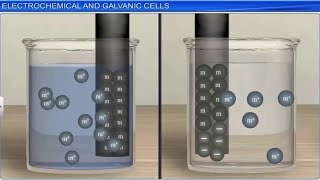

Unlock 6 Learning Videos
Sign up free to access all content, practice PYQs, and get AI explanations.
NEET PYQs — Electrochemistry
44 Sign up to accessShowing 3 of 44 questions. Sign up to practice all with answers, explanations, and AI help.
A solution of copper sulphate is electrolysed for 10 minutes with a current of 1.5 amperes. The mass of copper deposited at cathode is: (Given: Molar mass of Cu = 63 g mol⁻¹, 1F = 96487 C mol⁻¹)
Calculate emf of the half cell:
If the molar conductivity $(\Lambda_m)$ of a $0.050\ \mathrm{mol\ L^{-1}}$ solution of a monobasic weak acid is $90\ \mathrm{S\ cm^2\ mol^{-1}}$, its extent (degree) of dissociation will be [Assume $\Lambda_+^{\circ} = 349.6\ \mathrm{S\ cm^2\ mol^{-1}}$ and $\Lambda_-^{\circ} = 50.4\ \mathrm{S\ cm^2\ mol^{-1}}$.]
Unlock the full Electrochemistry experience
All diagrams, videos, quick revision, PYQ practice with AI explanations — plus mock tests, flashcards, and a personalised study plan.