
Electric Charges and Fields Notes
Study Notes
Topics
6Chapter Overview
Overview
Electric Charges and Fields introduces electrostatics, the study of charges at rest and the fields produced by them. The chapter begins with properties of electric charge, quantization, conservation, conductors, insulators and Coulomb’s law. It then develops electric field, field lines and continuous charge distribution. Electric flux prepares the foundation for Gauss’s law, which relates net electric flux through a closed surface to the charge enclosed. Electric dipole is important for torque, potential energy and fields on axial and equatorial lines. Applications of Gauss’s law give electric fields due to line charge, plane sheet, spherical shell and conductors. For NEET, this chapter is high-yield because questions are formula-based, conceptual and symmetry-based.
- 1NEET commonly asks direct numerical questions from Coulomb’s law, electric field, dipole torque and Gauss’s law.
- 2Electric field is a vector, so superposition requires vector addition.
- 3Electric flux is not the number of field lines exactly, but it is proportional to field lines crossing a surface.
- 4Gauss’s law is always true, but it is useful for finding electric field only when symmetry is high.
- 5A closed Gaussian surface counts only enclosed charge, not charges outside it.
- 6Conductors in electrostatic equilibrium have zero field inside and charge on the surface.
Chapter Flow Trick
Remember the flow: Charge makes Force, Force defines Field, Field gives Flux, Flux leads to Gauss.
Gauss Shortcut
Gauss counts only what is inside: flux through a closed surface depends on enclosed charge.
Real-Life Example
A rubbed plastic comb attracts tiny paper bits because charges are induced in paper and electrostatic force pulls them.
NEET-Style Snapshot
If distance between two charges is doubled, electrostatic force becomes one-fourth because F ∝ 1/r².
Forgetting Vector Nature
Coulomb force and electric field are vectors. Add directions carefully, not only magnitudes.
Using Gauss's Law Without Symmetry
Gauss’s law is always valid, but direct E calculation requires symmetry so E can be taken constant on the Gaussian surface.
Magnitude of electrostatic force between two point charges separated by distance r.
Variables
F=Electrostatic force
k=Coulomb constant, 8.99 × 10⁹ N m² C⁻²
q1, q2=Point charges
r=Separation between charges
ε0=Permittivity of free space
Force experienced per unit positive test charge.
Variables
E=Electric field intensity
F=Force on test charge
q0=Small positive test charge
Electric Charge & Coulomb's Law
Overview
Electric charge is a fundamental property of matter responsible for electrostatic force. Charges are of two types: positive and negative. Like charges repel and unlike charges attract. Charge is quantized, meaning any observable charge is an integral multiple of elementary charge e. Charge is also conserved, so total charge of an isolated system remains constant. Conductors allow charges to move freely, while insulators do not. Coulomb’s law gives the force between two stationary point charges: F = kq1q2/r². The force acts along the line joining the charges. For multiple charges, the net force is found by the superposition principle, adding individual forces vectorially.
- 1Elementary charge e = 1.6 × 10⁻¹⁹ C.
- 2A body cannot have charge 0.5e or 2.3e; charge must be ne.
- 3Electrostatic force can be attractive or repulsive depending on signs of charges.
- 4Coulomb’s law applies accurately to point charges or spherically symmetric charge distributions at large separation.
- 5In superposition, force between any pair is unaffected by presence of other charges.
- 6Permittivity of medium affects Coulomb force.
Charge Properties
Remember QCI: Quantized, Conserved, Invariant.
Coulomb Law
Force grows with charge product and falls with distance square: more charge means more force, more distance means much less force.
Given Coulomb Numerical
For q1 = 3 μC, q2 = 6 μC and r = 4 m, F = kq1q2/r² = 8.99 × 10⁹ × 3 × 10⁻⁶ × 6 × 10⁻⁶ / 4² ≈ 0.0101 N.
Quantization Example
If a body has charge -3.2 × 10⁻¹⁹ C, then n = q/e = -2, meaning it has gained 2 electrons.
NEET-Type Shortcut
If both charges are doubled and distance is doubled, force becomes same because F ∝ q1q2/r² gives factor 4/4.
Forgetting Microcoulomb Conversion
1 μC = 10⁻⁶ C. Always convert charges to coulomb before using k = 9 × 10⁹.
Ignoring Direction in Superposition
Forces must be added as vectors. Opposite directions subtract; perpendicular directions need Pythagoras.
Using Coulomb Law for Large Irregular Bodies Directly
Coulomb’s law in simple form is for point charges. Extended bodies need distribution methods or symmetry.
Any charge is an integral multiple of elementary charge.
Variables
q=Total charge
n=Integer number of electrons gained or lost
e=Elementary charge, 1.6 × 10⁻¹⁹ C
q1 and q2 are charges; r is distance. Gives the magnitude of electrostatic force between two point charges.
Variables
F=Magnitude of electrostatic force
k=8.99 × 10⁹ N m² C⁻²
q1=First charge in coulomb
q2=Second charge in coulomb
r=Distance between charges in metre
Electric Field & Field Lines
Overview
Electric field describes the influence of a charge in the space around it. It is defined as force per unit positive test charge, E = F/q0. The electric field due to a positive point charge is radially outward, while that due to a negative charge is radially inward. Field is a vector, so for multiple charges the net field is found by vector superposition. Electric field lines are visual tools: their tangent gives field direction and their density indicates field strength. Lines never intersect and begin on positive charges and end on negative charges. Continuous charge distributions such as line, surface and volume charges require integration or Gauss’s law, depending on symmetry.
- 1Electric field exists even if no test charge is placed.
- 2A test charge should be very small so it does not disturb the source charge distribution.
- 3At any point, only one electric field direction exists, so field lines cannot cross.
- 4Uniform electric field has parallel equally spaced field lines.
- 5Electric field inside a conductor in electrostatic equilibrium is zero.
- 6For continuous charge distributions, divide charge into small elements dq.
Field Line Direction
Field lines go from Plus to Minus: P to M means Positive to Negative.
Line Density
Crowded lines mean crowded force: stronger electric field.
Solved Example
Field due to q = 2 μC at r = 0.3 m is E = kq/r² = 9 × 10⁹ × 2 × 10⁻⁶ / 0.09 = 2 × 10⁵ N/C.
Previous NEET-Type Question
At the midpoint between equal and opposite charges, electric fields due to both charges are in the same direction, from positive to negative.
Drawing Intersecting Field Lines
Field lines never intersect because electric field cannot have two directions at one point.
Confusing Field with Force
Electric field depends on source charge only; force also depends on the test charge.
Defines electric field as force per unit positive test charge.
Variables
E=Electric field intensity
F=Force on test charge
q0=Positive test charge
Magnitude of field at distance r from a point charge q.
Variables
E=Electric field
k=Coulomb constant
q=Source charge
r=Distance from charge
Net field is vector sum of fields due to individual charges.
Variables
E_net=Resultant electric field
E1, E2, E3=Individual electric field vectors
Electric Flux
Overview
Electric flux measures the amount of electric field passing through a surface. For a uniform electric field through a plane surface, flux is Φ = EA cosθ, where θ is the angle between the electric field and the area vector. The area vector is always normal to the surface. Flux is maximum when the surface is perpendicular to the field and zero when the surface is parallel to the field. For curved or non-uniform situations, flux is calculated using integration: Φ = ∫E·dA. Through a closed surface, outward flux is taken positive and inward flux negative. Electric flux is central to Gauss’s law, where total closed-surface flux depends only on enclosed charge.
- 1Flux is a scalar quantity because it is a dot product.
- 2The angle θ is between electric field and area vector, not between field and surface.
- 3Solid angle helps describe how much a surface subtends at a point charge.
- 4Flux through a closed surface can be positive, negative or zero.
- 5Charges outside a closed surface contribute zero net flux through it.
- 6Flux gives a bridge between field-line visualization and Gauss’s law.
Angle Reminder
Flux angle is with Area vector, not with the surface. Area vector stands normal to the surface.
Maximum Flux Trick
Maximum flux occurs when field pierces the surface straight through, so E is parallel to A.
Solved Example
A surface of area 0.2 m² is placed perpendicular to E = 100 N/C. Since area vector is parallel to E, Φ = EA = 20 N m²/C.
Closed Surface Example
If no charge is enclosed by a closed surface, net flux is zero even if electric field exists due to outside charges.
Taking Angle with Surface
If the field makes angle α with the surface, then it makes 90° - α with the area vector.
Assuming Flux Must Always Be Positive
Flux through a closed surface can be negative if more field lines enter than leave.
Electric flux through a plane area in uniform electric field.
Variables
Φ=Electric flux
E=Uniform electric field
A=Area vector magnitude
θ=Angle between E and area vector
Used when field or surface direction changes from point to point.
Variables
Φ=Total electric flux
E=Electric field
dA=Small area vector
Electric Dipole
Overview
An electric dipole consists of two equal and opposite charges separated by a small distance. Its dipole moment is p = q × 2a, directed from negative charge to positive charge. Dipoles are important because many molecules behave as electric dipoles. The electric field of a dipole is different on its axial and equatorial lines. For a short dipole, axial field is twice the equatorial field in magnitude at the same large distance. In a uniform electric field, a dipole experiences no net force but experiences torque τ = pE sinθ, which tends to align it with the field. Its potential energy is U = -pE cosθ, minimum when aligned with the field.
- 1Dipole moment is a vector directed from -q to +q.
- 2Net force on a dipole in a uniform electric field is zero.
- 3Torque tries to align the dipole moment with the electric field.
- 4Dipole field falls as 1/r³, faster than point charge field which falls as 1/r².
- 5Axial field and equatorial field directions are different.
- 6Potential energy is minimum when p is parallel to E.
Dipole Moment Direction
Dipole moment goes from Minus to Plus: M to P.
Axial vs Equatorial
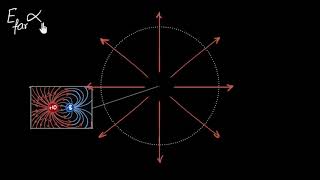
Axial field is double; Equatorial field is equal-half compared with axial at same r.
Solved Numerical
A dipole has q = 2 μC and separation 4 cm. p = q(2a) = 2 × 10⁻⁶ × 0.04 = 8 × 10⁻⁸ C m.
Torque Example
If p = 5 × 10⁻⁸ C m, E = 2 × 10⁵ N/C and θ = 90°, τ = pE sinθ = 10⁻² N m.
NEET-Type Question
A dipole is in stable equilibrium when p is parallel to E because U = -pE is minimum.
Wrong Direction of Dipole Moment
Electric dipole moment is from negative to positive charge, not from positive to negative.
Assuming Net Force in Uniform Field
In a uniform electric field, forces on +q and -q are equal and opposite, so net force is zero but torque may be non-zero.
Forgetting Equatorial Field Direction
On the equatorial line of a short dipole, electric field is opposite to dipole moment.
Magnitude of electric dipole moment.
Variables
p=Dipole moment
q=Magnitude of either charge
2a=Separation between charges
Electric field on axial line of a short dipole at distance r from its centre.
Variables
E_axial=Electric field on axial line
p=Dipole moment
r=Distance from dipole centre
ε0=Permittivity of free space
Magnitude of field on equatorial line; direction is opposite to dipole moment.
Variables
E_equatorial=Electric field on equatorial line
p=Dipole moment
r=Distance from dipole centre
Gauss's Law
Overview
Gauss’s law states that the total electric flux through any closed surface equals the net charge enclosed divided by permittivity of free space: ∮E·dA = q_enclosed/ε0. The closed surface chosen for applying the law is called a Gaussian surface. Gauss’s law is true for any closed surface, regular or irregular, but it becomes useful for calculating electric field only when symmetry allows E to be constant over parts of the surface. Common useful symmetries are spherical, cylindrical and planar. Charges outside the Gaussian surface may affect electric field at individual points, but their net contribution to total flux through the closed surface is zero.
- 1Gauss’s law is a flux law, not directly a force law.
- 2A Gaussian surface must be closed.
- 3Area vector for a closed surface is outward normal.
- 4To calculate E easily, E should be constant in magnitude on the chosen surface.
- 5If q_enclosed = 0, net flux is zero, but electric field need not be zero everywhere.
- 6Gauss’s law is especially powerful for infinite or highly symmetric charge distributions.
Gauss Law Core
Gauss sees only enclosed charge for net flux.
Surface Choice Trick
Sphere for spherical, cylinder for line, pillbox for plane.
Solved Example
If a closed surface encloses +3 μC and -1 μC, q_enclosed = +2 μC. Net flux = 2 × 10⁻⁶/ε0.
Concept Example
A charge outside a closed box may create electric field on the box surface, but net flux through the box is zero if no charge is enclosed.
Using Open Surface as Gaussian Surface
A Gaussian surface must be closed. An open sheet cannot directly enclose charge.
Thinking Zero Flux Means Zero Field
Net flux can be zero even when electric field exists, because inward and outward contributions cancel.
Counting Outside Charges in q Enclosed
Only charges inside the Gaussian surface are included in q_enclosed.
Net electric flux through a closed surface equals enclosed charge divided by ε0.
Variables
Φ=Net electric flux
q_enclosed=Net charge inside closed surface
ε0=Permittivity of free space
Integral form of Gauss’s law for any closed surface.
Variables
∮=Closed surface integral
E=Electric field
dA=Outward area vector element
q_enclosed=Charge enclosed
Applications of Gauss's Law
Overview
Applications of Gauss’s law use symmetry to calculate electric fields quickly. For an infinite line charge, cylindrical symmetry gives E = λ/(2πε0r), directed radially outward for positive charge. For an infinite plane sheet, planar symmetry gives E = σ/(2ε0), independent of distance. For a charged spherical shell, field outside behaves as if all charge were concentrated at the centre, while field inside the shell is zero. For conductors in electrostatic equilibrium, electric field inside the conducting material is zero, excess charge lies on the outer surface and field just outside is σ/ε0. Electrostatic shielding works because the field inside a closed conductor is zero.
- 1For line charge, choose a cylindrical Gaussian surface coaxial with the line.
- 2For plane sheet, choose a pillbox Gaussian surface cutting through the sheet.
- 3For spherical shell, choose a concentric spherical Gaussian surface.
- 4The field of an infinite plane sheet does not depend on distance.
- 5Inside a charged spherical shell, enclosed charge is zero, so electric field is zero.
- 6A conductor shields its cavity from external electrostatic fields if no charge is placed inside the cavity.
Three Famous Results
Line falls as 1/r, sheet is constant, shell is zero inside.
Conductor Shielding
Conductor cancels field inside: charges rearrange until internal E becomes zero.
Gaussian Surface Match
Line-cylinder, Sheet-pillbox, Shell-sphere.
Solved Example: Plane Sheet
For σ = 8.85 × 10⁻⁶ C/m², field due to an infinite non-conducting sheet is E = σ/(2ε0) = 8.85 × 10⁻⁶/(2 × 8.85 × 10⁻¹²) = 5 × 10⁵ N/C.
Previous NEET-Type Question
Electric field inside a charged spherical shell is zero because a Gaussian sphere inside encloses no charge.
Quick Revision Note
For an infinite line charge, if distance r is doubled, E becomes half because E ∝ 1/r.
Real-Life Application
A car can act like a Faraday cage during lightning because charges stay on the outer conducting surface, shielding the inside.
Using Sheet Formula for Conducting Surface
Infinite non-conducting sheet has E = σ/(2ε0), but just outside a conductor E = σ/ε0.
Thinking Spherical Shell Field Is Zero Outside
Inside a uniformly charged spherical shell E = 0; outside it behaves like a point charge at the centre.
Forgetting Direction
For positive charge distributions, field is outward; for negative distributions, field is inward.
Field at perpendicular distance r from an infinitely long line charge.
Variables
E=Electric field
λ=Linear charge density
ε0=Permittivity of free space
r=Distance from line charge
Field on either side of a uniformly charged infinite non-conducting plane sheet.
Variables
E=Electric field
σ=Surface charge density
ε0=Permittivity of free space
Electric field immediately outside a charged conductor surface.
Variables
E=Electric field just outside conductor
σ=Surface charge density on conductor
ε0=Permittivity of free space
Formula Sheet
10Magnitude of electrostatic force between two point charges separated by distance r.
Variables
F=Electrostatic force
k=Coulomb constant, 8.99 × 10⁹ N m² C⁻²
q1, q2=Point charges
r=Separation between charges
ε0=Permittivity of free space
Force experienced per unit positive test charge.
Variables
E=Electric field intensity
F=Force on test charge
q0=Small positive test charge
Flux through a plane surface in a uniform electric field.
Variables
Φ=Electric flux
E=Electric field
A=Area of surface
θ=Angle between electric field and area vector
Net electric flux through a closed surface equals enclosed charge divided by ε0.
Variables
E=Electric field
dA=Area vector element
q_enclosed=Net charge inside Gaussian surface
ε0=Permittivity of free space
Any charge is an integral multiple of elementary charge.
Variables
q=Total charge
n=Integer number of electrons gained or lost
e=Elementary charge, 1.6 × 10⁻¹⁹ C
5 more formulas locked
Sign up free to access all formulas with variables and explanations.
Quick Revision
12 Sign up to accessUnlock 12 Quick Revision Points
Sign up free to access all content, practice PYQs, and get AI explanations.
Learning Videos
6 Sign up to access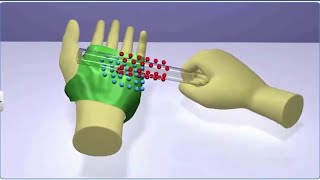


Unlock 6 Learning Videos
Sign up free to access all content, practice PYQs, and get AI explanations.
NEET PYQs — Electric Charges and Fields
24 Sign up to accessShowing 3 of 24 questions. Sign up to practice all with answers, explanations, and AI help.
Two identical charged conducting spheres A and B have their centres separated by a certain distance. Charge on each sphere is q and the force of repulsion between them is F. A third identical uncharged conducting sphere is brought in contact with sphere A first and then with B and finally removed from both. New force of repulsion between spheres A and B (Radius of A and B are negligible compared to the distance of separation so that for calculating force between them they can be considered as point charges) is best given as :
An electric dipole with dipole moment 5 × 10⁻⁶ Cm is aligned with the direction of a uniform electric field of magnitude 4 × 10⁵ N/C. The dipole is then rotated through an angle of 60° with respect to the electric field. The change in the potential energy of the dipole is :
Given below are two statements: one is labelled as Assertion A and the other is labelled as Reason R. Assertion A: The potential $V$ at any axial point, at $2\,m$ distance $(r)$ from the centre of the dipole of dipole moment vector $\vec{P}$ of magnitude $4\times10^{-6}\,C\,m$, is $\pm 9\times10^{3}\,V$. (Take: $\frac{1}{4\pi\varepsilon_0}=9\times10^9\;\text{SI units)}$ Reason R: $V = \pm \frac{2P}{4\pi\varepsilon_0 r^2}$ where r is the distance of any axial point situated at 2 m from the centre of the dipole. In the light of the above statements, choose the correct answer from the options given below:
Unlock the full Electric Charges and Fields experience
All diagrams, videos, quick revision, PYQ practice with AI explanations — plus mock tests, flashcards, and a personalised study plan.