
Units and Measurements Notes
Study Notes
Topics
5📖 Chapter Overview
Overview
Physics begins with measurement because every law becomes meaningful only when quantities are measured and compared. A physical quantity has a numerical value and a unit, such as 5 m or 2 kg. This chapter builds the language of physics: fundamental and derived quantities, SI units, significant figures, errors, dimensions and dimensional analysis. In NEET, this chapter is high-scoring because questions are often direct, formula-based and concept-checking. It also supports mechanics, heat, waves, electricity and modern physics. Mastering unit conversion, significant figures, error propagation and dimensional formulae helps avoid silly mistakes and quickly verify options in MCQs.
- 1NEET frequently asks SI units, dimensional formulae, significant figures and percentage error.
- 2Units may change with system, but dimensions of a physical quantity remain the same.
- 3Accuracy means closeness to true value; precision means closeness among repeated measurements.
- 4In addition and subtraction, result follows least decimal places; in multiplication and division, result follows least significant figures.
- 5For powers, fractional powers and products, percentage errors combine according to powers.
- 6Dimensionless quantities may have units, such as angle in radian, but their dimensional formula is [M0L0T0].
Seven SI Base Quantities
Mnemonic: 'Long Men Take Current Kilo Mole Candles' = Length, Mass, Time, Current, Kelvin temperature, Mole, Candela.
NEET Measurement Flow
Remember: Unit → Significant figures → Error → Dimension → Analysis. This is the usual order of solving measurement questions.
Real-Life Measurement
A doctor measuring body temperature, a mechanic measuring screw diameter and a physicist measuring time period all need standard units and uncertainty estimates.
NEET Use
If an option has dimension [ML2T-2], it may represent work, energy or torque, so dimensions help eliminate wrong choices quickly.
Confusing Unit and Dimension
Newton and dyne are different units, but both have the same dimension [MLT-2]. Units can change; dimensions do not.
Assuming All Exact Numbers Have Error
Counting numbers and defined constants usually do not limit significant figures; measured quantities do.
Ignoring Powers in Error Propagation
For x = a^2 b, percentage error in x is 2 percentage error in a plus percentage error in b.
Every measured physical quantity is written as a number multiplied by a standard unit.
Variables
Physical quantity=Measurable property such as length, mass, time or force
Unit=Standard reference used for comparison
Gives relative uncertainty in percentage form, useful for NEET numerical questions.
Variables
Δa=Absolute error in measured quantity
a=Measured or mean value of the quantity
📏 Units & SI System
Overview
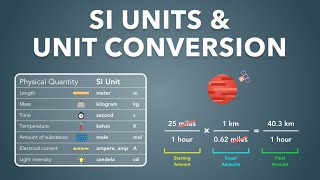
A physical quantity is anything that can be measured, such as length, mass, time, speed or force. It is expressed using a numerical value and a unit. Fundamental quantities are independent base quantities, while derived quantities are obtained from them using mathematical relations. The SI system is the internationally accepted system used in science and NEET. It contains seven base units and many derived units. Older systems such as CGS and FPS are still useful for conversions and historical questions. Prefixes like milli, micro, kilo and mega make very large or very small measurements convenient. NEET questions often test unit symbols, conversions and dimensions together.
- 1A unit must be well-defined, reproducible, accessible and invariant.
- 2SI base unit of mass is kilogram, not gram.
- 3Symbols are case-sensitive: m = metre, M = mega, mol = mole.
- 4Do not pluralize unit symbols: 5 kg, not 5 kgs.
- 5Derived units with special names include newton, joule, watt, pascal, coulomb and volt.
- 6Unit conversion can be done by multiplying by conversion factors equal to 1.
Base Units
Mnemonic: 'Mr Kg Saw Ampere Kelvin Mole Candela' = metre, kilogram, second, ampere, kelvin, mole, candela.
Small Prefix Order
milli, micro, nano, pico go down by 10^-3 each step: 10^-3, 10^-6, 10^-9, 10^-12.
Prefix Conversion
5 km = 5 × 10^3 m = 5000 m. 3 μs = 3 × 10^-6 s.
Derived Unit
Force = mass × acceleration, so SI unit = kg × m s^-2 = kg m s^-2 = newton.
Practice Question
Convert 72 km h^-1 into m s^-1. Answer: 72 × 5/18 = 20 m s^-1.
Wrong Capital Letters
Use K for kelvin, not k; use k for kilo, not K. Case matters in SI symbols.
Mixing Units
Do not put mass in grams and length in metres inside one SI formula unless the equation is adjusted.
Calling Radian a Base Unit
Radian was historically called supplementary; modern SI treats it as a dimensionless derived unit.
The same physical quantity has different numerical values in different units.
Variables
n1, n2=Numerical values in unit systems 1 and 2
u1, u2=Corresponding units
If Q has dimensions [M^aL^bT^c], convert mass, length and time units with their powers.
Variables
a,b,c=Powers of mass, length and time in dimensional formula
Q=Derived physical quantity
🔢 Significant Figures
Overview
Significant figures are the digits in a measured value that are reliably known, including the first uncertain digit. They indicate the precision of measurement. For example, 2.50 m is more precise than 2.5 m because it has three significant figures. Accuracy means closeness to the true value, while precision means repeatability or closeness of measured values to one another. Significant figure rules are essential in NEET because final numerical answers should not imply more precision than the data allow. The rules differ for addition-subtraction and multiplication-division. Scientific notation makes significant figures clear, especially for numbers containing zeros.
- 10.00450 has 3 significant figures: 4, 5 and final 0.
- 2500 may have 1, 2 or 3 significant figures unless written as 5 × 10^2, 5.0 × 10^2 or 5.00 × 10^2.
- 3Exact counted numbers do not limit significant figures.
- 4Final rounding should be done at the end, not at every intermediate step.
- 5More significant figures generally mean greater precision, not necessarily greater accuracy.
Zeros Rule
Remember: 'Left zeros leave, middle zeros matter, decimal-end zeros stay.'
Operations Shortcut
Add/subtract → decimal places. Multiply/divide → significant figures.
Worked Addition
12.11 + 18.0 + 1.013 = 31.123. Least decimal places = 1, so answer = 31.1.
Worked Multiplication
4.56 × 1.4 = 6.384. Least significant figures = 2, so answer = 6.4.
Practice MCQ
How many significant figures are in 0.02040? Answer: 4.
Counting Leading Zeros
In 0.00052, zeros only locate the decimal point; they are not significant.
Rounding Too Early
Keep extra digits during calculation and round only the final answer.
Using Multiplication Rule for Addition
2.34 + 1.2 must be rounded by decimal places, not total significant figures.
A number is written with clear significant figures using powers of ten.
Variables
N=Original number
a=Coefficient containing significant digits
n=Integer power of ten
For sums and differences, decimal place precision controls the answer.
Variables
Final decimal places=Number of digits retained after decimal in result
terms=Measured values being added or subtracted
🎯 Errors in Measurement
Overview
No measurement is perfectly exact because instruments, observers and conditions introduce uncertainty. Error is the difference between measured value and true value, though the true value is usually unknown. Repeated measurements are used to estimate the best value and uncertainty. Errors may be systematic, random or least count errors. Absolute error gives uncertainty in the same unit, relative error compares it with the measured value, and percentage error expresses it as a percent. Error propagation is crucial when measured quantities are combined in formulas. NEET often asks direct calculations of mean absolute error, percentage error and maximum percentage error in derived quantities.
- 1Systematic errors include instrumental, observational and environmental errors.
- 2Random errors can be reduced, not completely removed.
- 3Smaller least count generally means more precise instrument.
- 4Percentage error has no unit.
- 5For x = a^m b^n / c^p, maximum fractional error = m Δa/a + n Δb/b + p Δc/c.
- 6In NEET, maximum error is usually asked; signs are ignored and errors are added.
Error Types
Mnemonic: 'SIR-L' = Systematic, Instrumental/observational/environmental, Random, Least count.
Propagation Shortcut
Products, quotients and powers: add percentage errors after multiplying by powers.
Mean Absolute Error Example
Readings: 2.1, 2.2, 2.3 cm. Mean = 2.2 cm. Absolute errors = 0.1, 0, 0.1 cm. Mean absolute error = 0.067 cm.
Error Propagation Example
If density ρ = m/V, and errors in m and V are 1% and 3%, maximum percentage error in density = 4%.
NEET Shortcut
For T = 2π√(l/g), percentage error in T = 1/2 percentage error in l + 1/2 percentage error in g.
Using Signed Errors in Maximum Error
For maximum possible error, take magnitudes and add; do not cancel positive and negative errors.
Confusing Absolute and Relative Error
Absolute error has unit; relative and percentage errors do not have physical units.
Forgetting Power Multiplication
If radius has 2% error, area has 4% error because A ∝ r^2.
Best estimate of a measured quantity from repeated observations.
Variables
amean=Mean measured value
a1, a2, ..., an=Individual measurements
n=Number of observations
Magnitude of deviation of an observation from the mean value.
Variables
Δai=Absolute error of ith observation
ai=ith measured value
amean=Mean value
Average uncertainty estimated from repeated readings.
Variables
Δamean=Mean absolute error
Δa1, Δa2, ..., Δan=Absolute errors
📐 Dimensions & Dimensional Formulae
Overview
Dimensions show how a physical quantity depends on fundamental quantities such as mass, length, time, current and temperature. A dimensional formula expresses this dependence using powers, for example force has dimensional formula [MLT-2]. Units may differ from system to system, but dimensional formula remains the same for a physical quantity. Derived quantities are obtained from formulas using dimensions of base quantities. Some quantities such as strain, refractive index and relative density are dimensionless because they are ratios of similar quantities. Learning common dimensional formulae is extremely useful for NEET because it helps identify quantities, check equations and eliminate wrong options quickly.
- 1Write formula first, then substitute dimensions of each quantity.
- 2Use [M], [L], [T], [A], [K] for mass, length, time, current and temperature.
- 3Work, energy and torque have same dimensions [ML2T-2], but they are different physical quantities.
- 4Pressure and stress have same dimensions [ML-1T-2].
- 5Momentum and impulse have same dimensions [MLT-1].
- 6Dimensionless does not always mean unitless in practical naming; radian is a named dimensionless unit.
Core Chain
Remember the chain: velocity LT^-1, acceleration LT^-2, force MLT^-2, work ML2T^-2, power ML2T^-3.
Same Dimensions Pair
Momentum = impulse; work = energy = torque; pressure = stress; angular velocity = frequency.
Derived Quantity Example
Density = mass/volume = [M]/[L3] = [ML^-3].
Dimensionless Example
Strain = change in length/original length = [L]/[L] = [M0L0T0].
Practice MCQ
Which has dimensions [MLT^-1]? Answer: momentum and impulse.
Thinking Same Dimension Means Same Quantity
Work and torque have same dimensions but different physical meanings and vector nature.
Forgetting Area Dimension
Pressure = force/area; area is L2, so pressure is [MLT-2]/[L2] = [ML-1T-2].
Treating All Constants as Dimensionless
G, h and k may be constants but they have dimensions.
General dimensional expression using fundamental dimensions commonly needed in NEET physics.
Variables
Q=Physical quantity
M,L,T,A,K=Mass, length, time, electric current and temperature dimensions
Velocity is rate of change of displacement.
Variables
v=Velocity
L,T=Length and time dimensions
Force is mass multiplied by acceleration.
Variables
F=Force
m=Mass
a=Acceleration
⚡ Dimensional Analysis & Applications
Overview
Dimensional analysis uses the principle of dimensional homogeneity: in a correct physical equation, every term added or equated must have the same dimensions. This makes it a powerful NEET tool for checking formulas, eliminating wrong options and deriving relations between quantities. For example, the time period of a simple pendulum can be shown to depend on √(l/g), though dimensional analysis cannot find the constant 2π. It can also convert values from one unit system to another using dimensional powers. However, it cannot handle equations involving trigonometric, exponential or logarithmic functions unless their arguments are dimensionless, and it cannot distinguish between quantities with the same dimensions.
- 1For checking equations, write dimensions of LHS and RHS and compare.
- 2For deriving relations, assume Q ∝ a^x b^y c^z and solve powers.
- 3For unit conversion, use n2 = n1(M1/M2)^a(L1/L2)^b(T1/T2)^c.
- 4Dimensional homogeneity is necessary but not sufficient for correctness.
- 5Dimensionless constants such as 2, π and 1/2 are not obtained.
- 6NEET options can often be eliminated by checking dimensions only.
Homogeneity Rule
Mnemonic: 'Only Same Dimensions Can Sum' — you can add length to length, not length to velocity.
Limitations
Remember 'No CPS': no Constants, no Plus-minus signs, no Same-dimension distinction.
Checking Correctness
Check v^2 = u^2 + 2as. v^2 has [L2T^-2]; as has [LT^-2][L] = [L2T^-2]. Hence dimensionally correct.
Deriving Relation
For time period of pendulum, T = k l^x g^y gives x = 1/2 and y = -1/2, so T ∝ √(l/g).
Typical NEET Question
If an option for energy has dimension [MLT^-2], reject it because energy must be [ML2T^-2].
Thinking Dimensionally Correct Means Always Correct
s = ut + at^2 is dimensionally correct, but the correct equation has 1/2 before at^2 for uniformly accelerated motion.
Adding Unlike Dimensions
An equation like v = u + at^2 is wrong because at^2 has dimension of length, not velocity.
Forgetting Dimensionless Arguments
In sin(ωt), ωt must be dimensionless; hence ω has dimension T^-1.
A physically meaningful equation must have same dimensions on both sides.
Variables
LHS=Left-hand side of equation
RHS=Right-hand side of equation
Assume dependence on variables, compare dimensions and solve for powers x, y and z.
Variables
Q=Quantity whose relation is to be derived
k=Dimensionless constant not found by dimensional analysis
a,b,c=Relevant physical variables
x,y,z=Unknown powers
Formula Sheet
10Every measured physical quantity is written as a number multiplied by a standard unit.
Variables
Physical quantity=Measurable property such as length, mass, time or force
Unit=Standard reference used for comparison
Gives relative uncertainty in percentage form, useful for NEET numerical questions.
Variables
Δa=Absolute error in measured quantity
a=Measured or mean value of the quantity
Represents dimensions of a physical quantity using powers of fundamental dimensions.
Variables
Q=Physical quantity
a,b,c,d,e,f,g=Powers of base dimensions
The same physical quantity has different numerical values in different units.
Variables
n1, n2=Numerical values in unit systems 1 and 2
u1, u2=Corresponding units
If Q has dimensions [M^aL^bT^c], convert mass, length and time units with their powers.
Variables
a,b,c=Powers of mass, length and time in dimensional formula
Q=Derived physical quantity
5 more formulas locked
Sign up free to access all formulas with variables and explanations.
Quick Revision
12 Sign up to accessUnlock 12 Quick Revision Points
Sign up free to access all content, practice PYQs, and get AI explanations.
Learning Videos
6 Sign up to access

Unlock 6 Learning Videos
Sign up free to access all content, practice PYQs, and get AI explanations.
NEET PYQs — Units and Measurements
34 Sign up to accessShowing 3 of 34 questions. Sign up to practice all with answers, explanations, and AI help.
In a vernier caliper, 20 VSD coincide with 16 MSD (each division length 1 mm). The least count of the vernier calipers is:
Each side of a metallic cube of mass 5.580 kg is measured to be 9.0 cm. Keeping the significant figures in view, the density of the material of the cube can be best expressed as X × 10³ kg m⁻³ where the value of X is:
The speed of light in vacuum is taken as unity. If light takes 6 min 40 s to reach the Earth from the Sun, the distance between the Sun and the Earth in new unit is:
Unlock the full Units and Measurements experience
All diagrams, videos, quick revision, PYQ practice with AI explanations — plus mock tests, flashcards, and a personalised study plan.