
Motion in a Plane Notes
Study Notes
Topics
6📖 1. Chapter Overview
Overview
Motion in a plane extends straight-line motion to two dimensions, usually described using x and y coordinates. Many real situations such as projectile motion, circular motion, boat crossing a river, rain seen by a moving person and airplane motion in wind require two-dimensional analysis. The chapter begins with scalar and vector quantities, then explains vector addition, subtraction, dot product, cross product and resolution into components. The key idea is that motion along perpendicular axes can often be treated independently. For NEET, this chapter is highly important because it combines conceptual vector questions, formula-based projectile numericals, relative velocity problems and circular motion applications.
- 1In plane motion, x and y components are solved separately and then combined vectorially.
- 2A scalar has magnitude only; a vector has magnitude and direction.
- 3Vector diagrams are essential for NEET relative velocity and projectile questions.
- 4Projectile range is maximum at 45 degrees on level ground.
- 5Complementary projection angles give the same horizontal range for equal speed.
- 6Velocity in circular motion is tangential while centripetal acceleration is radial inward.
Chapter Flow
Remember V-R-P-C: Vectors, Resolution, Projectile, Circular motion.
Component Method
Break first, solve separately, combine finally.
Daily Life Example
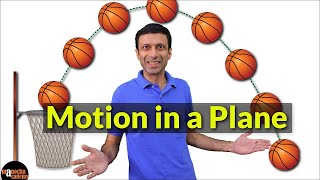
A basketball shot, a water stream from a hose, a boat crossing a river and a car turning on a circular track are all examples of motion in a plane.
Quick Check
If a ball is projected horizontally, its horizontal velocity remains constant while vertical velocity increases due to gravity.
Treating Vector Magnitudes Like Algebraic Numbers
Vectors must be added using direction. Two vectors of 5 N and 5 N can have resultant from 0 to 10 N depending on angle.
Mixing Components
Do not use vertical acceleration in horizontal projectile equations. In ideal projectile motion, ax = 0 and ay = -g.
Forgetting Direction in Relative Velocity
Relative velocity is vector subtraction, not always simple subtraction of speeds.
Magnitude of a vector from its rectangular components.
Variables
|A|=Magnitude of vector A
Ax=x-component of vector A
Ay=y-component of vector A
Horizontal range of an oblique projectile on level ground.
Variables
R=Horizontal range
u=Initial speed
θ=Angle of projection
g=Acceleration due to gravity
📍 2. Scalars & Vectors
Overview
Physical quantities are measurable properties used to describe nature. Some quantities, such as mass, time, temperature, distance and speed, need only magnitude and are called scalars. Others, such as displacement, velocity, acceleration, force and momentum, need both magnitude and direction and are called vectors. In two-dimensional motion, vectors are represented by arrows or by components along coordinate axes. Equal vectors have the same magnitude and direction, while negative vectors have the same magnitude but opposite direction. Unit vectors show direction with magnitude one. Understanding zero, parallel, anti-parallel and position vectors is essential before solving vector operations, projectile motion and relative velocity problems.
- 1A vector is unchanged if shifted parallel to itself without changing magnitude and direction.
- 2In 2D, position vector is r = xi + yj.
- 3Unit vectors i and j represent positive x and positive y directions.
- 4Magnitude of a vector is always non-negative.
- 5Negative sign before a vector reverses its direction, not its magnitude.
- 6Types of vectors include equal, negative, zero, unit, position, parallel, anti-parallel, coinitial and coplanar vectors.
Scalar vs Vector
Scalar says 'how much'; vector says 'how much and where'.
Unit Vector
Unit vector is a direction tag: magnitude one, direction same.
Real-Life Vector
A wind blowing at 20 km/h east is a vector because both speed and direction are required.
Position Vector Example
A point at (3 m, 4 m) has position vector r = 3i + 4j and magnitude 5 m.
Calling Speed a Vector
Speed has no direction. Velocity is the vector quantity.
Thinking Negative Vector Has Negative Magnitude
Magnitude is never negative. The negative sign reverses direction.
Confusing Equal and Parallel Vectors
Parallel vectors need not have equal magnitude; equal vectors must have same magnitude and same direction.
Vector from origin to a point with coordinates (x, y).
Variables
r=Position vector
x=Coordinate along x-axis
y=Coordinate along y-axis
i, j=Unit vectors along x and y axes
Length of a vector from its rectangular components.
Variables
|A|=Magnitude of vector A
Ax=x-component
Ay=y-component
➕ 3. Vector Operations
Overview
Vector operations allow us to combine physical quantities that have direction. Vector addition can be performed by triangle law, parallelogram law or polygon law. In triangle law, the tail of the second vector is placed at the head of the first; the resultant goes from the first tail to the last head. Subtraction means adding the negative vector. Multiplication by a scalar changes magnitude and may reverse direction if the scalar is negative. Dot product gives a scalar and is used in work done and projections. Cross product gives a vector perpendicular to the plane of the two vectors and is used in torque, angular momentum and magnetic force.
- 1Vector addition is commutative: A + B = B + A.
- 2Vector subtraction is not commutative: A - B is generally not equal to B - A.
- 3Dot product is maximum when vectors are parallel and zero when perpendicular.
- 4Cross product is zero when vectors are parallel and maximum when perpendicular.
- 5Work done W = F · s depends on component of force along displacement.
- 6Right hand rule: curl fingers from first vector to second; thumb gives A × B direction.
Dot vs Cross
Dot gives how much along; cross gives how much perpendicular.
Maximum Rules
Dot loves parallel, cross loves perpendicular.
Subtraction Trick
Never subtract directly. Reverse the second vector and add.
Solved Resultant
Two vectors of 3 units and 4 units at 90 degrees have resultant R = √(9 + 16) = 5 units.
Work Example
A force of 10 N acts at 60 degrees to displacement 5 m. Work = 10 × 5 × cos60 = 25 J.
NEET Trick
For two equal vectors A at angle 120 degrees, resultant is A because R = √(A^2 + A^2 + 2A^2 cos120) = A.
Adding Magnitudes Directly
A + B is not always A + B numerically. It depends on the angle between vectors.
Forgetting Cross Product Direction
A × B and B × A have opposite directions.
Using sin Instead of cos in Work
Work done is F · s = Fs cosθ, not Fs sinθ.
Magnitude of resultant of two vectors A and B with angle θ between them.
Variables
R=Magnitude of resultant vector
A, B=Magnitudes of two vectors
θ=Angle between vectors
Angle α made by resultant with vector A.
Variables
α=Angle of resultant with A
A, B=Magnitudes of vectors
θ=Angle between A and B
Subtracting a vector means adding its opposite vector.
Variables
A, B=Vectors
-B=Vector equal in magnitude and opposite in direction to B
🎯 4. Resolution & Relative Velocity
Overview
Resolution of vectors means splitting a vector into components along chosen axes. Rectangular components along x and y axes are most common because perpendicular components are independent. If a vector A makes angle θ with x-axis, Ax = A cosθ and Ay = A sinθ. Components can also be taken along an inclined plane or arbitrary axes if they simplify the problem. Relative velocity describes velocity of one object as observed from another and is found by vector subtraction. Boat-river, rain-man and airplane-wind problems are all relative velocity applications. The safest NEET method is to draw vectors, resolve into components and then apply the required condition.
- 1Always attach cos to the component adjacent to the angle and sin to the opposite component.
- 2Along an inclined plane, weight components are mg sinθ down the plane and mg cosθ perpendicular to plane.
- 3For shortest river crossing time, boat should head perpendicular to river bank.
- 4For zero drift while crossing river, boat must aim upstream with suitable component cancelling river velocity.
- 5Rain appears vertical to a moving person when horizontal component of relative rain velocity is zero.
- 6Airplane ground velocity is the vector sum of airplane velocity relative to air and wind velocity.
Component Rule
Cos is close to the angle; sin is away from the angle.
Relative Velocity
Velocity of A with respect to B means remove B: vAB = vA - vB.
Boat Shortcut
Shortest time: aim straight across. No drift: aim upstream.
Component Example
A 10 N force at 30 degrees to x-axis has Fx = 10 cos30 = 5√3 N and Fy = 10 sin30 = 5 N.
Boat Example
River width is 100 m and boat speed in still water is 5 m/s. For shortest time, t = 100/5 = 20 s, independent of river speed.
Rain-Man NEET Style
If rain falls vertically at 10 m/s and man runs horizontally at 10 m/s, relative rain makes 45 degrees with vertical.
Using sin and cos in Wrong Places
Check where the angle is measured. The component adjacent to the angle gets cos.
Treating River Velocity as Acceleration
River current adds velocity, not acceleration.
Wrong Umbrella Direction
The umbrella must be aligned opposite to relative rain velocity, not actual rain velocity alone.
Components of vector A when θ is measured from positive x-axis.
Variables
A=Magnitude of vector
Ax=Component along x-axis
Ay=Component along y-axis
θ=Angle with x-axis
A vector can be written as sum of its component vectors.
Variables
A=Original vector
i, j=Unit vectors along x and y axes
Find vector magnitude and direction from components.
Variables
|A|=Magnitude of vector
θ=Direction angle from x-axis
🏃 5. Motion in a Plane
Overview
Motion in a plane is described by position, displacement, velocity and acceleration vectors that change with time. A particle at coordinates (x, y) has position vector r = xi + yj. Its displacement is the change in position vector. Velocity is the rate of change of position vector, and acceleration is the rate of change of velocity vector. When acceleration is constant, the equations of motion can be applied separately along x and y directions. Parametric equations x(t) and y(t) describe the path of the particle by eliminating time if required. This component method is the foundation for projectile motion, relative motion and many NEET numerical problems.
- 1Two-dimensional motion can be treated as two simultaneous one-dimensional motions.
- 2Components along perpendicular axes are independent.
- 3The velocity vector is tangent to the path at every point.
- 4Acceleration may change speed, direction or both.
- 5Constant acceleration in a plane does not always mean straight-line motion.
- 6Projectile motion is a special case with ax = 0 and ay = -g.
Vector Kinematics Chain
r changes to v, v changes to a: position → velocity → acceleration.
Component Independence
x never asks y for permission; y never asks x. Solve separately.
Displacement Vector Example
A particle moves from (2, 3) m to (8, 6) m. Displacement = 6i + 3j and magnitude = √45 = 3√5 m.
Velocity Components Example
If vx = 3 m/s and vy = 4 m/s, speed = √(3^2 + 4^2) = 5 m/s.
Parametric Example
If x = 2t and y = 5t^2, the motion is two-dimensional because both coordinates vary with time.
Assuming Constant Acceleration Means Straight Path
Projectile motion has constant acceleration but curved parabolic path.
Confusing Position Vector and Displacement Vector
Position is from origin; displacement is from initial point to final point.
Forgetting Velocity Direction
Velocity is tangent to the path, not necessarily in the direction of acceleration.
Locates the particle in a two-dimensional coordinate system.
Variables
r=Position vector
x, y=Coordinates of the particle
i, j=Unit vectors along x and y axes
Change in position vector between two points.
Variables
Δr=Displacement vector
x1, y1=Initial coordinates
x2, y2=Final coordinates
Rate of change of position vector with time.
Variables
v=Velocity vector
vx, vy=Velocity components along x and y axes
🏹 6. Projectile Motion
Overview
Projectile motion is the motion of an object projected into air and then moving under the effect of gravity alone, neglecting air resistance. It is a two-dimensional motion with horizontal and vertical components. Horizontally, acceleration is zero, so horizontal velocity remains constant. Vertically, acceleration is g downward, so vertical velocity changes uniformly. In oblique projection, initial velocity is resolved as ux = u cosθ and uy = u sinθ. Important results include time of flight, maximum height, horizontal range, trajectory equation and velocity components at any instant. For level ground, range is maximum at 45 degrees and complementary angles give the same range.
- 1At highest point, vertical velocity is zero but horizontal velocity remains u cosθ.
- 2Acceleration is always g downward throughout projectile motion.
- 3Trajectory is parabolic when air resistance is neglected.
- 4For horizontal projection, initial vertical velocity is zero.
- 5Complementary angles θ and 90° - θ have equal range for same speed on level ground.
- 6Time of ascent equals time of descent only when landing level equals projection level.
Projectile Split
Horizontal is steady, vertical is gravity-ready.
Maximum Range
Range loves sin2θ; sin2θ is maximum at 90°, so θ = 45°.
Complementary Angles
θ and 90° - θ share the same sin2θ, so they share the same range.
Solved Example
A projectile is fired at 20 m/s at 30 degrees. Time of flight = 2×20×sin30/10 = 2 s. Range = 20^2×sin60/10 = 20√3 m.
Maximum Height Example
For u = 10 m/s and θ = 30 degrees, H = 100×(1/2)^2/(2×10) = 1.25 m.
Horizontal Projection Example
A ball rolls off a table with horizontal speed 5 m/s and falls for 2 s. Horizontal distance = 5×2 = 10 m.
Using g in Horizontal Motion
Gravity acts vertically, so horizontal acceleration is zero in ideal projectile motion.
Taking Velocity Zero at Highest Point
Only vertical velocity is zero at the highest point. Horizontal velocity remains u cosθ.
Using Range Formula for Unequal Heights
R = u^2 sin2θ/g is valid only when projection and landing points are at the same level.
Initial velocity of oblique projectile resolved into horizontal and vertical parts.
Variables
u=Initial speed
θ=Angle of projection with horizontal
ux=Initial horizontal velocity
uy=Initial vertical velocity
Parametric equations of an oblique projectile from origin.
Variables
x, y=Horizontal and vertical coordinates
t=Time after projection
g=Acceleration due to gravity
Total time for projectile to return to same vertical level.
Variables
T=Time of flight
u sinθ=Initial vertical velocity
Greatest vertical height reached by an oblique projectile.
Variables
H=Maximum height
u=Initial speed
θ=Projection angle
🔄 7. Uniform Circular Motion
Overview
Uniform circular motion is motion of a body along a circular path with constant speed. Although speed remains constant, velocity continuously changes direction, so the motion is accelerated. This acceleration is centripetal acceleration and always points toward the centre of the circle. The force responsible for this inward acceleration is centripetal force, which may be tension, friction, gravity or normal force depending on the situation. Angular displacement measures the angle swept by the radius vector, angular velocity measures its rate of change, and angular acceleration measures change in angular velocity. Period and frequency describe repetition. NEET often asks formulas for centripetal acceleration, centripetal force, v-r-ω relation and real applications.
- 1Centripetal force is not a new force; it is the name of the required inward net force.
- 2In uniform circular motion, tangential acceleration is zero but radial acceleration is non-zero.
- 3Angular displacement is measured in radians.
- 4One full revolution corresponds to 2π radians.
- 5For a stone tied to a string, tension provides centripetal force.
- 6For satellite motion, gravity provides centripetal force.
- 7For a car on a flat circular track, friction provides centripetal force.
Velocity and Acceleration
Velocity touches the circle; acceleration targets the centre.
Centripetal Formula
Two faces of inward acceleration: v²/r and ω²r.
Force Provider
Centripetal force is a role, not a separate force; tension, gravity or friction may play that role.
Stone Tied to String
When a stone is whirled in a circle, string tension acts toward the centre and provides centripetal force.
Numerical Example
A body of mass 2 kg moves in a circle of radius 1 m with speed 4 m/s. Centripetal force = mv²/r = 2×16/1 = 32 N.
Satellite Example
A satellite stays in orbit because gravitational force continuously bends its velocity toward Earth, acting as centripetal force.
Previous NEET-Style Question
If speed is doubled at the same radius, centripetal acceleration becomes four times because ac ∝ v².
Thinking Uniform Circular Motion Has Zero Acceleration
Speed is constant, but velocity direction changes continuously, so acceleration is non-zero.
Drawing Centripetal Acceleration Tangentially
Centripetal acceleration always points toward the centre, not along the tangent.
Calling Centripetal Force a New Force
Centripetal force is the net inward force required for circular motion, provided by real forces.
Angle swept by radius vector in radians.
Variables
θ=Angular displacement in radians
s=Arc length
r=Radius
Rate of change of angular displacement.
Variables
ω=Angular velocity
θ=Angular displacement
T=Time period
f=Frequency
Rate of change of angular velocity.
Variables
α=Angular acceleration
ω=Angular velocity
t=Time
Relation between tangential speed and angular velocity.
Variables
v=Linear or tangential speed
r=Radius
ω=Angular velocity
Formula Sheet
10Magnitude of a vector from its rectangular components.
Variables
|A|=Magnitude of vector A
Ax=x-component of vector A
Ay=y-component of vector A
Horizontal range of an oblique projectile on level ground.
Variables
R=Horizontal range
u=Initial speed
θ=Angle of projection
g=Acceleration due to gravity
Acceleration required to keep a body moving in a circular path.
Variables
ac=Centripetal acceleration
v=Linear speed
r=Radius of circular path
ω=Angular velocity
Vector from origin to a point with coordinates (x, y).
Variables
r=Position vector
x=Coordinate along x-axis
y=Coordinate along y-axis
i, j=Unit vectors along x and y axes
Length of a vector from its rectangular components.
Variables
|A|=Magnitude of vector A
Ax=x-component
Ay=y-component
5 more formulas locked
Sign up free to access all formulas with variables and explanations.
Quick Revision
12 Sign up to accessUnlock 12 Quick Revision Points
Sign up free to access all content, practice PYQs, and get AI explanations.
Learning Videos
6 Sign up to access

Unlock 6 Learning Videos
Sign up free to access all content, practice PYQs, and get AI explanations.
NEET PYQs — Motion in a Plane
26 Sign up to accessShowing 3 of 26 questions. Sign up to practice all with answers, explanations, and AI help.
Two cities X and Y are connected by a regular bus service with a bus leaving in either direction every T min. A girl is driving scooty with a speed of 60 km/h in the direction X to Y notices that a bus goes past her every 30 minutes in the direction of her motion, and every 10 minutes in the opposite direction. Choose the correct option for the period T of service and the speed (assumed constant) of the buses.
A particle moving with uniform speed in a circular path maintains:
A bullet is fired from a gun at the speed of 280 m s⁻¹ in the direction 30° above the horizontal. The maximum height attained by the bullet is : (g = 9.8 m s⁻², sin 30° = 0.5)
Unlock the full Motion in a Plane experience
All diagrams, videos, quick revision, PYQ practice with AI explanations — plus mock tests, flashcards, and a personalised study plan.