
Oscillations Notes
Study Notes
Topics
5Chapter Overview
Overview
Oscillations deals with repeated motion about a mean position. The chapter begins with periodic motion and oscillatory motion, then focuses on simple harmonic motion, where acceleration is directly proportional to displacement and directed towards the mean position. SHM is described using sine or cosine equations, phase, angular frequency, velocity and acceleration. The chapter further connects SHM with restoring force, Hooke’s law, kinetic energy, potential energy and conservation of mechanical energy. Finally, the simple pendulum is studied as an approximate SHM system for small angular displacement. For NEET, this chapter is highly formula-based and commonly tests time period, frequency, spring systems, pendulum variations, energy and graph interpretation.
- 1NEET often asks direct time period and maximum velocity or acceleration questions.
- 2Graph-based questions usually require phase relation between displacement, velocity and acceleration.
- 3Energy continuously changes between kinetic and potential forms in SHM.
- 4The time period of a spring-mass system does not depend on amplitude for ideal SHM.
- 5The time period of a simple pendulum depends on length and gravity, not on mass.
- 6Small-angle approximation is essential for pendulum SHM.
Chapter Flow Trick
Remember the flow: Repeat → SHM condition → x, v, a → Force → Energy → Pendulum.
SHM Core Identity
SHM means acceleration says: I go opposite to displacement, and my size grows with displacement.
Real-Life Example
A swing, vibrating guitar string, mass attached to a spring and small oscillations of a pendulum all show oscillatory behaviour.
NEET-Style Shortcut
If the time period of a pendulum is asked after length becomes four times, T becomes two times because T ∝ √L.
Confusing Periodic and Oscillatory Motion
All ideal oscillatory motions are periodic, but every periodic motion is not necessarily oscillatory. Uniform circular motion is periodic but not to-and-fro about a mean position.
Using Degree Instead of Radian in Angular Formulae
Angular frequency and phase in SHM formulae are normally used in radians.
Relates time period and frequency of any periodic motion.
Variables
T=Time taken for one complete oscillation
f=Number of oscillations per second
Angular frequency measures phase change per unit time.
Variables
ω=Angular frequency in rad s⁻¹
f=Frequency in hertz
T=Time period
Gives displacement of a particle performing SHM at time t.
Variables
x=Displacement from mean position
A=Amplitude
ω=Angular frequency
t=Time
ϕ=Initial phase
Periodic Motion
Overview
Periodic motion is any motion that repeats itself after equal intervals of time. The fixed time after which the motion repeats is called time period, and the number of repetitions per second is frequency. Oscillatory motion is a special periodic to-and-fro motion about a mean position. A motion becomes physically important in oscillations when displacement, velocity, acceleration and restoring force change regularly with time. Angular frequency tells how fast the phase of oscillation changes. The important characteristics of oscillations are amplitude, time period, frequency, angular frequency, phase and mean position. NEET questions from this topic usually check definitions, unit conversion and graph interpretation.
- 1Periodic motion need not always be SHM.
- 2Oscillatory motion requires a stable equilibrium or mean position.
- 3For one full cycle, phase changes by 2π radians.
- 4Greater frequency means smaller time period.
- 5Amplitude affects maximum displacement but not time period in ideal SHM systems.
T and f Trick
T is Time for one; f is how Frequent per second. So they are reciprocals.
Periodic vs Oscillatory
Oscillatory means 'O' for 'Opposite directions repeatedly'; periodic only means repeated.
Uniform Circular Motion
It is periodic because the particle returns to the same point after every revolution, but it is not oscillatory because it does not move to-and-fro about a mean position.
Solved Example
If a body completes 20 oscillations in 10 s, f = 20/10 = 2 Hz and T = 1/f = 0.5 s.
Calling Every Periodic Motion SHM
SHM needs the special condition a = -ω²x. Repetition alone is not enough.
Forgetting SI Units
Frequency is in hertz, time period in seconds and angular frequency in rad s⁻¹.
Frequency is reciprocal of time period.
Variables
f=Frequency in hertz
T=Time period in seconds
Converts ordinary frequency into angular frequency.
Variables
ω=Angular frequency in rad s⁻¹
f=Frequency in hertz
Simple Harmonic Motion
Overview
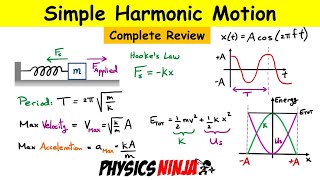
Simple Harmonic Motion is a special oscillatory motion in which acceleration is directly proportional to displacement from the mean position and is always directed towards the mean position. Mathematically, a = -ω²x. The negative sign is the signature of restoring nature. SHM can be represented by x = A sin(ωt + ϕ) or x = A cos(ωt + ϕ), where amplitude, angular frequency and phase completely describe the motion. A powerful way to understand SHM is as the projection of uniform circular motion on a diameter. Many systems show approximate SHM, such as a spring-mass system, small oscillations of a pendulum and vibrations of atoms.
- 1The restoring acceleration must point towards mean position.
- 2The mean position is the stable equilibrium position.
- 3The choice of sine or cosine depends on initial condition.
- 4A phase difference of 2π means same phase; π means opposite phase.
- 5Uniform circular motion analogy helps derive displacement, velocity and acceleration in SHM.
- 6Ideal SHM time period is independent of amplitude.
SHM Definition Trick
SHM = Same Home Motion: acceleration always pulls the particle back home to the mean position.
Negative Sign Meaning
In a = -ω²x, the minus sign means restoring direction, not negative magnitude.
Solved Example
If x = 5 sin(10t) cm, amplitude A = 5 cm, angular frequency ω = 10 rad s⁻¹ and time period T = 2π/10 = π/5 s.
Previous NEET-Type Question
A particle has acceleration a = -16x. Since a = -ω²x, ω = 4 rad s⁻¹ and T = 2π/4 = π/2 s.
Examples of SHM
Horizontal spring-mass system, vertical spring-mass system, small-angle simple pendulum and vibrations of atoms about equilibrium are standard SHM examples.
Forgetting Direction in SHM Condition
Writing a ∝ x is incomplete and wrong for SHM. Correct condition is a ∝ -x.
Mixing Initial Phase
Use sine or cosine according to initial position and velocity. If motion starts from extreme position, cosine form is often easiest.
The defining equation of simple harmonic motion.
Variables
a=Acceleration
ω=Angular frequency
x=Displacement from mean position
General sinusoidal expression for displacement in SHM.
Variables
x=Instantaneous displacement
A=Amplitude
ω=Angular frequency
t=Time
ϕ=Initial phase
Represents the state of oscillation at time t.
Variables
θ=Phase at time t
ω=Angular frequency
t=Time
ϕ=Initial phase
Velocity & Acceleration in SHM
Overview
In SHM, velocity and acceleration continuously change with position and time. If displacement is x = A sin(ωt + ϕ), then velocity is v = Aω cos(ωt + ϕ), so velocity is maximum at the mean position and zero at extreme positions. Acceleration is a = -ω²x, so it is zero at the mean position and maximum in magnitude at the extremes. Velocity is 90° ahead of displacement in phase, while acceleration is 180° out of phase with displacement. These relations are central for NEET because many questions ask maximum velocity, maximum acceleration, speed at a given displacement and interpretation of v-t and a-t graphs.
- 1Speed is maximum where restoring force is zero.
- 2Acceleration is maximum where displacement is maximum.
- 3The sign of velocity depends on direction of motion.
- 4The sign of acceleration is always opposite to displacement.
- 5In graph questions, compare phase and not only shape.
- 6At x = A/2, speed is v = ωA√3/2.
Mean and Extreme Trick
At Mean: maximum speed, minimum acceleration. At Extreme: maximum acceleration, zero speed.
Acceleration Direction
Acceleration always points Home, towards the mean position.
Solved Numerical
A particle has A = 0.10 m and ω = 20 rad s⁻¹. Maximum velocity = Aω = 2 m s⁻¹ and maximum acceleration = Aω² = 40 m s⁻².
Numerical Problem
If A = 8 cm and x = 4 cm, speed is v = ω√(A² - x²) = ω√(64 - 16) cm s⁻¹ = 4√3ω cm s⁻¹.
Taking Maximum Acceleration at Mean Position
At mean position, x = 0, so a = -ω²x = 0. Maximum acceleration occurs at extremes.
Ignoring ± Sign in Velocity
The formula v = ±ω√(A² - x²) has two signs because the particle can pass the same position in two directions.
Velocity obtained by differentiating displacement x = A sin(ωt + ϕ).
Variables
v=Instantaneous velocity
A=Amplitude
ω=Angular frequency
t=Time
ϕ=Initial phase
Gives speed or velocity at a particular displacement from mean position.
Variables
v=Velocity at displacement x
ω=Angular frequency
A=Amplitude
x=Displacement from mean position
Maximum speed occurs at the mean position.
Variables
v_max=Maximum velocity or speed
A=Amplitude
ω=Angular frequency
Force & Energy in SHM
Overview
Force and energy give the physical cause and behaviour of SHM. A restoring force always acts towards the mean position and tries to bring the particle back. For a spring, Hooke’s law gives F = -kx, which matches the SHM condition because acceleration becomes a = -(k/m)x. During SHM, kinetic energy is maximum at the mean position and zero at extremes, while potential energy is zero at the mean position and maximum at extremes. Total mechanical energy remains constant in ideal SHM and equals 1/2 kA² or 1/2 mω²A². NEET commonly tests energy at a given displacement and conservation of energy in spring systems.
- 1The negative sign in F = -kx shows restoring direction.
- 2At mean position, potential energy is minimum and kinetic energy is maximum.
- 3At extremes, kinetic energy is zero and potential energy is maximum.
- 4Total energy depends on square of amplitude.
- 5If amplitude doubles, total energy becomes four times.
- 6Energy-time graphs have frequency twice that of displacement because energy depends on square of sine or cosine.
Energy Location Trick
Mean means Motion maximum, so KE is maximum. Extreme means Extension maximum, so PE is maximum.
Amplitude Energy Trick
Energy depends on A-square. Double amplitude means four times energy.
Solved Example
If k = 200 N m⁻¹ and A = 0.10 m, total energy E = 1/2 kA² = 1/2 × 200 × 0.01 = 1 J.
NEET-Type Question
If amplitude of SHM becomes 3 times, total energy becomes 9 times because E ∝ A².
Energy at Half Amplitude
At x = A/2, PE = 1/2 k(A²/4) = E/4 and KE = 3E/4.
Forgetting Total Energy Is Constant
In ideal SHM without damping, KE and PE change, but their sum remains constant.
Wrong Sign in Hooke’s Law
F = -kx, not simply kx. The negative sign shows that force opposes displacement.
Thinking Vertical Spring Has Different Time Period
For an ideal vertical spring-mass system, gravity shifts equilibrium position but time period remains T = 2π√(m/k).
Hooke’s law for a spring; force is opposite to displacement.
Variables
F=Restoring force
k=Spring constant
x=Displacement from equilibrium
Angular frequency for an ideal mass-spring oscillator.
Variables
ω=Angular frequency
k=Spring constant
m=Attached mass
Time period of a horizontal or vertical ideal spring-mass system.
Variables
T=Time period
m=Mass
k=Spring constant
Simple Pendulum
Overview
A simple pendulum consists of a small heavy bob suspended by a light, inextensible string from a fixed support. When displaced slightly and released, the bob oscillates about its mean position. For small angular displacement, sinθ ≈ θ, so the restoring torque becomes proportional to angular displacement and the motion is approximately SHM. Its time period is T = 2π√(L/g), where L is the effective length from point of suspension to the centre of the bob. The period depends on length and acceleration due to gravity, but not on mass of the bob. Energy changes between gravitational potential energy at extremes and kinetic energy at the mean position.
- 1The restoring component of weight is mg sinθ towards mean position.
- 2For small θ, motion becomes SHM because restoring torque is proportional to displacement.
- 3A pendulum clock runs slow if g decreases or length increases.
- 4At extreme positions, speed is zero and potential energy is maximum.
- 5At mean position, speed and kinetic energy are maximum.
- 6The formula T = 2π√(L/g) is valid for small oscillations only.
Pendulum Formula Memory
Pendulum loves Length and Gravity only: T = 2π√(L/g). Mass is missing, so mass does not matter.
Clock Trick
Low g makes T large, so a pendulum clock runs slow at high altitude or on the Moon.
Solved Numerical
For L = 1 m and g = 9.8 m s⁻², T = 2π√(1/9.8) ≈ 2.0 s.
Previous NEET-Type Question
If length becomes 4L, new time period T' = 2π√(4L/g) = 2T.
Practice Problem
A pendulum is taken to a place where g becomes one-fourth. Since T ∝ 1/√g, new time period becomes 2T.
Application
A pendulum can be used to determine g by measuring L and T, then using g = 4π²L/T².
Using Pendulum Formula for Large Angles
T = 2π√(L/g) is derived using sinθ ≈ θ and is valid only for small angular displacement.
Measuring Length Incorrectly
Effective length is from suspension point to centre of bob, not just the string length unless bob radius is negligible.
Thinking Mass Affects Time Period
Mass cancels out in the pendulum equation, so heavier and lighter bobs have the same ideal time period for the same L and g.
Time period of a simple pendulum for small oscillations.
Variables
T=Time period
L=Effective length of pendulum
g=Acceleration due to gravity
Frequency is reciprocal of time period.
Variables
f=Frequency
g=Acceleration due to gravity
L=Effective length
Angular frequency for small oscillations of a simple pendulum.
Variables
ω=Angular frequency
g=Acceleration due to gravity
L=Effective length
Formula Sheet
10Relates time period and frequency of any periodic motion.
Variables
T=Time taken for one complete oscillation
f=Number of oscillations per second
Angular frequency measures phase change per unit time.
Variables
ω=Angular frequency in rad s⁻¹
f=Frequency in hertz
T=Time period
Gives displacement of a particle performing SHM at time t.
Variables
x=Displacement from mean position
A=Amplitude
ω=Angular frequency
t=Time
ϕ=Initial phase
Time period of a mass attached to an ideal spring.
Variables
T=Time period
m=Mass attached to spring
k=Spring constant
Time period of a simple pendulum for small angular oscillations.
Variables
T=Time period
L=Effective length of pendulum
g=Acceleration due to gravity
5 more formulas locked
Sign up free to access all formulas with variables and explanations.
Quick Revision
12 Sign up to accessUnlock 12 Quick Revision Points
Sign up free to access all content, practice PYQs, and get AI explanations.
Learning Videos
6 Sign up to access

Unlock 6 Learning Videos
Sign up free to access all content, practice PYQs, and get AI explanations.
NEET PYQs — Oscillations
35 Sign up to accessShowing 3 of 35 questions. Sign up to practice all with answers, explanations, and AI help.
For a simple pendulum having time period T, the variation of kinetic energy (K.E.) with time (t) is represented by:
Savitha, a XI standard student, while conducting an experiment to determine the effective length of a simple pendulum L, notes down the data of time taken to complete 30 oscillations as 60 s and hence calculates the length of the simple pendulum as: (Take π² = 9.8 and g = 9.8 m/s²)
The sum of kinetic energy and potential energy of a simple pendulum bob is 0.02 joule. The speed of the simple pendulum bob at equilibrium position is approximately: (Consider mass of the bob = 20 g)
Unlock the full Oscillations experience
All diagrams, videos, quick revision, PYQ practice with AI explanations — plus mock tests, flashcards, and a personalised study plan.