
Atoms Notes
Study Notes
Topics
5Chapter Overview
Overview
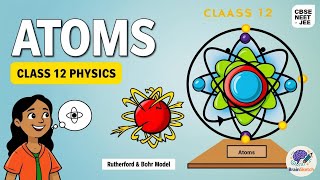
The chapter Atoms explains how our idea of atomic structure developed from Rutherford’s nuclear atom to Bohr’s quantized model and finally to the wave nature of electrons. Rutherford’s alpha scattering experiment proved that the atom has a tiny, dense, positively charged nucleus. Atomic spectra revealed that atoms emit or absorb only definite frequencies, which classical physics could not explain. Bohr introduced stationary orbits, quantized angular momentum, energy levels, excitation and ionization. The hydrogen spectrum is understood through transitions between energy levels using the Rydberg formula. de Broglie’s matter-wave idea explains why only certain electron orbits are allowed. For NEET, this chapter is formula-heavy, concept-based, and frequently tested through direct numerical questions.
- 1The atom is electrically neutral but contains a tiny positive nucleus and surrounding electrons.
- 2Classical mechanics fails for atomic stability and line spectra.
- 3Bohr combined Rutherford’s nuclear model with Planck’s quantum idea.
- 4Only transitions between allowed energy levels produce spectral lines.
- 5The Rydberg formula connects wavelength with initial and final quantum numbers.
- 6Matter waves give a physical explanation for stable electron orbits as standing waves.
- 7NEET often asks radius, velocity, energy, wavelength, frequency, excitation energy and ionization energy.
Chapter Logic Trick
Remember the order as R-S-B-H-D: Rutherford sees nucleus, Spectra show lines, Bohr explains orbits, Hydrogen gives series, de Broglie explains why orbits are allowed.
Energy Sign Trick
Bound electron energy is negative. Zero energy means the electron is just free from the atom.
NEET-Style Direct Fact
The ground state energy of hydrogen is -13.6 eV. Energy needed to ionize it from ground state is +13.6 eV.
Real-Life Link
Different colours in discharge tubes and neon signs occur because atoms emit light of characteristic wavelengths.
Using Bohr Model for All Atoms
Bohr formulas are directly valid only for hydrogen and hydrogen-like one-electron species. Do not apply them to multi-electron atoms unless explicitly approximated.
Confusing Excitation and Ionization
Excitation means electron moves to a higher bound orbit. Ionization means electron is completely removed to n = ∞.
Wrong Transition Direction
Emission occurs when electron moves from higher n to lower n. Absorption occurs when it moves from lower n to higher n.
Gives the wavelength of radiation emitted or absorbed during transition in a hydrogen-like atom.
Variables
λ=Wavelength of spectral line
R=Rydberg constant, approximately 1.097 × 10⁷ m⁻¹
Z=Atomic number of hydrogen-like species
n₁=Lower or final energy level
n₂=Higher or initial energy level
Radius of the nth permitted orbit for a hydrogen-like atom.
Variables
rₙ=Radius of nth Bohr orbit
n=Principal quantum number
Z=Atomic number
Rutherford Model
Overview
Rutherford’s model came from the alpha particle scattering experiment, where fast alpha particles were directed at a very thin gold foil. Most alpha particles passed straight through, a few were slightly deflected, and a very small number rebounded through large angles. Rutherford concluded that most of the atom is empty space, positive charge and nearly all mass are concentrated in a tiny central nucleus, and electrons revolve around it. The nuclear size was found to be much smaller than atomic size, about 10⁻¹⁵ m compared with atomic size around 10⁻¹⁰ m. However, the model failed to explain atomic stability and line spectra because revolving electrons should radiate energy continuously according to classical electromagnetic theory.
- 1The experiment used a radioactive alpha source, a thin gold foil and a fluorescent zinc sulphide screen.
- 2Scattering is due to electrostatic repulsion between alpha particles and the positive nucleus.
- 3The probability of large deflection is very small because the nucleus occupies very little volume.
- 4The nuclear model replaced Thomson’s plum pudding model.
- 5Classical physics predicts an accelerating electron should radiate energy, making Rutherford’s atom unstable.
- 6Rutherford model provided the foundation for Bohr’s model.
Observation Trick
Most-Some-Few: Most passed straight, Some deflected, Few bounced back. This directly gives Empty atom, Positive centre, Tiny dense nucleus.
Size Trick
Atom is 10⁻¹⁰ m and nucleus is 10⁻¹⁵ m. Remember: atom has 10, nucleus has 15; nucleus is smaller by 10⁵ in radius.
Analogy
If the atom were a huge stadium, the nucleus would be like a tiny object near the centre; most of the stadium would be empty.
NEET Numerical Sense
If atomic radius is 10⁻¹⁰ m and nuclear radius is 10⁻¹⁵ m, the ratio of radii is 10⁵ and the ratio of volumes is about 10¹⁵.
Thinking Alpha Particles Are Electrons
Alpha particles are positively charged helium nuclei, not electrons. Their positive charge causes repulsion from the positive nucleus.
Saying Nucleus Contains All Atomic Volume
The nucleus contains nearly all mass but occupies a tiny fraction of volume.
Ignoring Classical Instability
Rutherford model fails because revolving electrons are accelerated charges and should continuously lose energy.
Approximate relation for nuclear radius, showing that nuclear size depends on mass number.
Variables
R=Radius of nucleus
R₀=Constant of order 1.2 × 10⁻¹⁵ m
A=Mass number
Atomic Spectra
Overview
Atomic spectra are the patterns of light obtained when radiation from atoms is separated by a prism or diffraction grating. A hot solid, liquid, or dense gas usually gives a continuous spectrum containing all wavelengths. A low-pressure excited gas gives an emission line spectrum consisting of bright lines at specific wavelengths. When white light passes through a cooler gas, the gas absorbs its characteristic wavelengths and forms a dark-line absorption spectrum. For isolated atoms, spectra are not continuous because atomic energy is quantized. Hydrogen shows several spectral series produced by electron transitions to fixed lower levels. These spectral lines were among the strongest evidences against classical atomic models and led to Bohr’s quantized energy levels.
- 1Spectra are formed by transitions between quantized atomic energy levels.
- 2Emission happens when an electron falls from higher to lower energy.
- 3Absorption happens when an electron absorbs a photon and jumps to higher energy.
- 4The same element absorbs the same wavelengths that it emits.
- 5Line spectra are used to identify elements in stars and gases.
- 6A smaller wavelength corresponds to higher frequency and higher photon energy.
- 7Hydrogen spectrum is mathematically described by the Rydberg formula.
Emission vs Absorption
Emission = Exit energy as light, electron comes down. Absorption = Accept energy, electron goes up.
Spectrum Identity
Think of line spectrum as an atomic barcode: every element has its own fixed pattern of lines.
Astronomy Example
The elements present in stars are identified by comparing their absorption lines with laboratory spectra.
Discharge Tube Example
Hydrogen gas in a discharge tube emits characteristic coloured lines because electrons de-excite between fixed levels.
Calling Hydrogen Spectrum Continuous
Hydrogen gives a line spectrum, not a continuous spectrum, because electron energies are quantized.
Wrong Energy-Wavelength Relation
Higher energy means higher frequency but smaller wavelength. Do not say high energy means large wavelength.
Mixing Bright and Dark Lines
Emission lines are bright. Absorption lines are dark at the same wavelengths for the same gas.
Energy carried by a photon of frequency ν or wavelength λ.
Variables
E=Photon energy
h=Planck constant
ν=Frequency of radiation
c=Speed of light
λ=Wavelength
The photon energy equals the difference between two atomic energy levels.
Variables
ΔE=Difference between two energy levels
E₂=Higher energy level
E₁=Lower energy level
ν=Frequency of emitted or absorbed radiation
Bohr Model
Overview
Bohr’s model corrected Rutherford’s instability problem by introducing quantum postulates. According to Bohr, electrons revolve around the nucleus only in certain permitted stationary orbits without radiating energy. The angular momentum of the electron is quantized as mvr = nh/2π. Radiation is emitted or absorbed only when an electron jumps between two stationary orbits, with photon energy hν equal to the energy difference. For hydrogen-like atoms, Bohr derived formulas for orbit radius, electron velocity and energy. The model explains hydrogen spectrum, excitation energy and ionization energy very well. Its limitations are that it fails for multi-electron atoms, fine structure, Zeeman effect and the full wave nature of electrons.
- 1Bohr postulates combine Rutherford’s nucleus with Planck’s quantum theory.
- 2Negative energy means the electron is bound to the nucleus.
- 3As n increases, radius increases and total energy approaches zero.
- 4Ground state is n = 1 and has minimum energy.
- 5Excited states have n > 1.
- 6Ionization corresponds to n = ∞ where E = 0.
- 7For hydrogen, first excitation energy is 10.2 eV and ionization energy is 13.6 eV.
Bohr Postulates
Remember S-Q-J: Stationary orbits, Quantized angular momentum, Jump radiation.
Radius-Energy Trend
r grows with n², energy goes toward zero. Larger orbit means less tightly bound electron.
Hydrogen Energies
13.6, 3.4, 1.51 eV are magnitudes for n = 1, 2, 3 because divide 13.6 by n².
Solved Numerical: Radius
For He+ in n=2, r₂ = 0.529 × 2²/2 Å = 1.058 Å.
Solved Numerical: Energy
For Li2+ in n=3, E₃ = -13.6 × 3²/3² = -13.6 eV.
Solved Numerical: First Excitation of Hydrogen
E₁ = -13.6 eV and E₂ = -3.4 eV, so excitation energy = 10.2 eV.
Forgetting Negative Sign in Energy
Eₙ is negative for bound states. Ionization energy is positive because it is energy supplied.
Confusing n₁ and n₂
In emission, n₂ is initial higher level and n₁ is final lower level. Always ensure n₂ > n₁ in the Rydberg formula.
Applying Bohr to Multi-Electron Atoms
Bohr formulas are not exact for atoms like helium atom or lithium atom; they are exact only for one-electron ions such as He+ and Li2+.
Only those orbits are allowed in which angular momentum is an integral multiple of ℏ.
Variables
m=Mass of electron
v=Speed of electron
r=Radius of orbit
n=Principal quantum number
ℏ=Reduced Planck constant, h/2π
Radius of nth orbit in a hydrogen-like atom.
Variables
rₙ=Radius of nth orbit
n=Orbit number
Z=Atomic number
Speed of electron in nth orbit of a hydrogen-like atom.
Variables
vₙ=Electron speed in nth orbit
Z=Atomic number
n=Orbit number
Hydrogen Spectrum
Overview
Hydrogen spectrum is the most important application of Bohr’s model. When an electron in hydrogen jumps from a higher energy level to a lower energy level, it emits a photon whose wavelength is determined by the Rydberg formula. A group of lines ending at the same lower level is called a spectral series. Transitions ending at n = 1 form the Lyman series in the ultraviolet region. Transitions ending at n = 2 form the Balmer series, partly visible. Transitions ending at n = 3, 4 and 5 form the Paschen, Brackett and Pfund series respectively in the infrared region. Series limit occurs when the initial level n₂ becomes infinity, giving the shortest wavelength and maximum energy in that series.
- 1Rydberg formula is the central formula for hydrogen spectrum.
- 2For emission spectrum, electron falls from n₂ to n₁ where n₂ > n₁.
- 3For a fixed n₁, as n₂ increases, wavelength decreases and approaches the series limit.
- 4Lyman has the highest energy photons among hydrogen series because transitions end at n = 1.
- 5Balmer is important because many of its lines are visible.
- 6The first line of a series occurs for n₂ = n₁ + 1 and has the longest wavelength in that series.
- 7The limiting line occurs for n₂ = ∞ and has the shortest wavelength.
Series Order
Remember L-B-P-B-P as Lazy Boys Play Better Piano: Lyman, Balmer, Paschen, Brackett, Pfund.
Final n Trick
Series final levels are simply 1, 2, 3, 4, 5 in the same order: Lyman 1, Balmer 2, Paschen 3, Brackett 4, Pfund 5.
Region Trick
Only Balmer is famous for visible lines. Lyman is UV; Paschen, Brackett and Pfund are IR.
Solved Numerical: Lyman First Line
For transition 2→1 in hydrogen, 1/λ = R(1 - 1/4) = 3R/4.
Solved Numerical: Balmer Series Limit
For Balmer limit, n₁ = 2 and n₂ = ∞, so 1/λ = R/4 and λ = 4/R.
Identification Example
A transition ending at n = 3 belongs to the Paschen series, regardless of whether it starts from n = 4, 5, 6 or higher.
Confusing Initial and Final Levels
The series name depends on final level n₁, not the initial level n₂.
Wrong Series Limit
Series limit is not the first line. It occurs for n₂ = ∞ and gives the shortest wavelength.
Saying All Balmer Lines Are Visible
Balmer series is associated with the visible region, but not every Balmer transition must be treated as visibly coloured in all contexts.
Wavelength of hydrogen spectral line for transition from n₂ to n₁.
Variables
λ=Wavelength of spectral line
R=Rydberg constant, 1.097 × 10⁷ m⁻¹
n₁=Final lower orbit
n₂=Initial higher orbit
Obtained when n₂ = ∞ for a fixed final level n₁.
Variables
λ_limit=Shortest wavelength of the series
R=Rydberg constant
n₁=Final orbit defining the series
de Broglie Explanation
Overview
de Broglie proposed that moving particles have wave nature along with particle nature. The wavelength associated with a particle is λ = h/p = h/mv. For an electron moving in a Bohr orbit, only those circular paths are stable in which the electron wave forms a standing wave. This means the circumference of the orbit must contain a whole number of wavelengths: 2πr = nλ. Substituting λ = h/mv gives mvr = nh/2π, which is exactly Bohr’s quantization of angular momentum. Thus de Broglie’s idea gives a physical explanation for why only certain electron orbits are allowed. Wave-particle duality is experimentally supported by electron diffraction and is fundamental to modern quantum physics.
- 1Wave nature is significant for microscopic particles like electrons because their wavelength is measurable.
- 2For macroscopic objects, de Broglie wavelength is extremely small and not noticeable.
- 3A stable electron orbit is possible only when the wave joins smoothly with itself.
- 4If circumference is not an integral multiple of wavelength, destructive interference makes the orbit unstable.
- 5de Broglie idea connects particle momentum with wave wavelength.
- 6Wave-particle duality does not mean the electron is sometimes only wave and sometimes only particle; it shows both aspects depending on experiment.
- 7This explanation supports Bohr’s postulate instead of assuming it without reason.
Formula Trick
de Broglie connects Wave and Particle: λ is wave, p is particle, and h is the bridge: λ = h/p.
Allowed Orbit Trick
Allowed orbit means the electron wave says, 'I must meet myself perfectly after one round.' That is 2πr = nλ.
Momentum-Wavelength Trick
Fast and heavy means high momentum, so wavelength becomes tiny.
Solved Numerical: Electron Wavelength
If an electron has momentum p = 6.63 × 10⁻²⁴ kg m/s, then λ = h/p = 6.63 × 10⁻³⁴ / 6.63 × 10⁻²⁴ = 10⁻¹⁰ m.
Bohr Quantization Derivation
From 2πr = nλ and λ = h/mv, we get 2πr = nh/mv. Rearranging gives mvr = nh/2π.
Real-Life Experimental Significance
Electron diffraction by crystals confirms that electrons behave like waves, because diffraction is a wave phenomenon.
Using λ = h/mv for Photons
For photons, use p = h/λ and E = pc. The formula λ = h/mv is for material particles with rest mass in non-relativistic motion.
Ignoring Units
Use mass in kg, speed in m/s and h in J s to get wavelength in metre.
Thinking Any Circular Orbit Is Allowed
Only orbits where circumference equals an integral number of wavelengths are allowed.
Wavelength associated with any moving particle.
Variables
λ=Matter wave wavelength
h=Planck constant
p=Momentum of particle
Used when a particle of mass m moves with speed v much less than speed of light.
Variables
m=Mass of particle
v=Speed of particle
h=Planck constant
λ=de Broglie wavelength
Wavelength of an electron accelerated from rest through potential difference V.
Variables
λ=de Broglie wavelength of electron
h=Planck constant
m=Mass of electron
e=Electronic charge
V=Accelerating potential difference
Formula Sheet
10Gives the wavelength of radiation emitted or absorbed during transition in a hydrogen-like atom.
Variables
λ=Wavelength of spectral line
R=Rydberg constant, approximately 1.097 × 10⁷ m⁻¹
Z=Atomic number of hydrogen-like species
n₁=Lower or final energy level
n₂=Higher or initial energy level
Radius of the nth permitted orbit for a hydrogen-like atom.
Variables
rₙ=Radius of nth Bohr orbit
n=Principal quantum number
Z=Atomic number
Total energy of electron in nth orbit of hydrogen-like atom.
Variables
Eₙ=Energy of nth orbit
Z=Atomic number
n=Principal quantum number
Wavelength associated with a moving particle such as an electron.
Variables
λ=de Broglie wavelength
h=Planck constant
p=Momentum
m=Mass of particle
v=Speed of particle
Approximate relation for nuclear radius, showing that nuclear size depends on mass number.
Variables
R=Radius of nucleus
R₀=Constant of order 1.2 × 10⁻¹⁵ m
A=Mass number
5 more formulas locked
Sign up free to access all formulas with variables and explanations.
Quick Revision
12 Sign up to accessUnlock 12 Quick Revision Points
Sign up free to access all content, practice PYQs, and get AI explanations.
Learning Videos
3 Sign up to access

Unlock 3 Learning Videos
Sign up free to access all content, practice PYQs, and get AI explanations.
NEET PYQs — Atoms
24 Sign up to accessShowing 3 of 24 questions. Sign up to practice all with answers, explanations, and AI help.
Energy and radius of first Bohr orbit of $\mathrm{He}^+$ and $\mathrm{Li}^{2+}$ are given.
A particle of mass $m$ is moving around the origin with a constant force $F$ pulling it towards the origin. If Bohr model is used to describe its motion, the radius $r$ of the $n^{th}$ orbit and the particle’s speed $v$ in the orbit depend on $n$ as
Given below are two statements: Statement I: Atoms are electrically neutral as they contain equal number of positive and negative charges. Statement II: Atoms of each element are stable and emit their characteristic spectrum. In the light of the above statements, choose the most appropriate answer from the options given below:
Unlock the full Atoms experience
All diagrams, videos, quick revision, PYQ practice with AI explanations — plus mock tests, flashcards, and a personalised study plan.