
Work, Energy and Power Notes
Study Notes
Topics
6📖 1. Chapter Overview
Overview
Work, Energy and Power connects force with motion using energy methods. Work is done when a force causes displacement, and it depends on the component of force along displacement. Energy is the capacity to do work and appears as kinetic energy, potential energy, spring energy, heat and other forms. The work-energy theorem states that net work done on a body equals change in kinetic energy. Conservation laws help solve problems quickly when forces are conservative and mechanical energy remains constant. Power measures the rate of doing work, while efficiency compares useful output to input. For NEET, this chapter is very important because it simplifies motion, spring, collision and conservation problems.
- 1Work is a scalar, but it may be positive, negative or zero.
- 2Energy and work have the same SI unit: joule.
- 3Work-energy theorem is valid for both conservative and non-conservative forces.
- 4Mechanical energy is conserved only when non-conservative work is zero.
- 5Area under force-displacement graph gives work done.
- 6In collisions, momentum is conserved if external impulse is negligible, but kinetic energy is conserved only in elastic collisions.
Work Sign
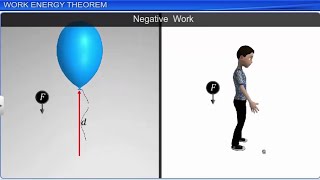
Force with motion is positive work; force against motion is negative work; force perpendicular to motion is zero work.
Energy Method
When forces vary or path is curved, think energy before equations of motion.
Daily Life Example
A motor lifts water by doing work against gravity, converting electrical energy into gravitational potential energy.
NEET Quick Check
If a force of 10 N acts perpendicular to displacement 5 m, work done is 10 × 5 × cos90° = 0.
Confusing Work and Force
A force can act without doing work if displacement is zero or perpendicular to force.
Assuming Mechanical Energy Always Conserved
Mechanical energy is conserved only when non-conservative work, such as frictional work, is zero.
Ignoring Units
Work and energy are in joule; power is in watt.
Work done is the product of force, displacement and cosine of the angle between them.
Variables
W=Work done
F=Magnitude of force
s=Displacement
θ=Angle between force and displacement
Net work done by all forces equals change in kinetic energy.
Variables
W_net=Net work done
K_f=Final kinetic energy
K_i=Initial kinetic energy
🔨 2. Work & Work-Energy Theorem
Overview
Work is done when a force produces displacement of its point of application. For a constant force, work is W = Fs cosθ, where θ is the angle between force and displacement. Work is positive when force helps motion, negative when force opposes motion and zero when force is perpendicular to displacement or displacement is zero. For variable force, work is found by adding small works and equals area under the force-displacement graph. When multiple forces act, net work is the sum of work done by all forces or work done by the resultant force. The work-energy theorem states that net work done on a particle equals change in kinetic energy.
- 1Normal reaction does zero work on a block moving horizontally on a fixed surface.
- 2Friction usually does negative work during sliding.
- 3Centripetal force does zero work in uniform circular motion because it is perpendicular to displacement.
- 4Work done by multiple forces can be calculated separately and added.
- 5Work-energy theorem uses net work, not work by only one force unless specified.
- 6The theorem is valid even when forces are variable.
Work Sign Shortcut
Along = plus, against = minus, perpendicular = zero.
Work-Energy Theorem
Net work is the energy bill: it tells exactly how kinetic energy changes.
Solved NEET Example
A 2 kg body speeds up from 3 m/s to 5 m/s. Net work = 1/2×2×(25 - 9) = 16 J.
Constant Force Example
A 20 N force pulls a block through 4 m at 60 degrees. Work = 20×4×cos60 = 40 J.
Stopping Example
If friction does -100 J work on a moving object, its kinetic energy decreases by 100 J.
Using Distance Instead of Displacement Direction
Work depends on displacement direction and the angle between force and displacement.
Taking Normal Work as Non-Zero
For a block moving on a fixed horizontal surface, normal is perpendicular to displacement, so its work is zero.
Using One Force Instead of Net Work
Work-energy theorem requires total work done by all forces.
Work is the dot product of force and displacement.
Variables
W=Work done
F=Force magnitude
s=Displacement magnitude
θ=Angle between force and displacement
Work done by a variable force along x-direction is the area under F-x curve.
Variables
F(x)=Force as a function of position
dx=Small displacement
⚡ 3. Kinetic & Potential Energy
Overview
Kinetic energy is the energy possessed by a body due to motion. For translational motion, K = 1/2 mv², so it depends on mass and square of speed. It is also related to momentum by K = p²/2m. Work done by net force changes kinetic energy. Potential energy is energy stored because of position or configuration. Near Earth’s surface, gravitational potential energy is U = mgh relative to a chosen reference level. More generally, gravitational potential energy is negative and depends on separation from Earth or another mass. Mechanical energy is the sum of kinetic and potential energies. Many problems involve conversion between kinetic and potential energy.
- 1Doubling speed makes kinetic energy four times.
- 2Potential energy depends on the selected zero level, but change in potential energy is physically meaningful.
- 3General gravitational potential energy is U = -GMm/r.
- 4Near Earth approximation mgh is valid when height is small compared to Earth’s radius.
- 5Mechanical energy may remain constant even though kinetic and potential energy individually change.
- 6Energy is scalar, so signs come from reference choices and work relations, not direction like vectors.
Kinetic Energy Speed Rule
Speed double means kinetic energy four times.
Potential Energy Reference
PE is like altitude on a map: zero level is chosen, but height difference matters.
Kinetic Energy Example
A 2 kg body moving at 5 m/s has K = 1/2×2×25 = 25 J.
Momentum Relation Example
A body with momentum 10 kg m/s and mass 2 kg has K = p²/2m = 100/4 = 25 J.
Potential Energy Example
A 3 kg mass raised by 4 m gains U = mgh = 3×10×4 = 120 J.
Forgetting Square in Kinetic Energy
Kinetic energy depends on v², so small speed changes strongly affect energy.
Treating Potential Energy as Absolute
Only change in potential energy is physically important in most mechanics problems.
Using Velocity Direction in Kinetic Energy
Kinetic energy depends on speed, not direction, so it is never negative.
Energy possessed by a body due to translational motion.
Variables
K=Kinetic energy
m=Mass
v=Speed
Relates kinetic energy to linear momentum.
Variables
p=Linear momentum
m=Mass
Net work done on a body changes its kinetic energy.
Variables
W_net=Net work
ΔK=Change in kinetic energy
🌍 4. Variable Force & Conservative Forces
Overview
A variable force changes in magnitude or direction during motion. Its work cannot generally be calculated by simple W = Fs cosθ; instead, the displacement is divided into small parts and work is integrated. Graphically, work done by a force along a line is the area under the force-displacement graph. Conservative forces are special forces for which work depends only on initial and final positions, not on path. Gravity and spring force are common examples. For conservative forces, work done equals negative change in potential energy. Non-conservative forces, such as friction and air resistance, depend on path and usually convert mechanical energy into heat.
- 1Constant force work is a special case of variable force work.
- 2If F-x graph is below the x-axis, work contribution is negative.
- 3Potential energy can be defined only for conservative forces.
- 4Gravity does the same work between two heights regardless of path.
- 5Friction does more negative work for longer path length.
- 6Spring force is variable and conservative.
Conservative Force
Conservative cares about endpoints, not route.
F-x Graph
Work is the area story under the force-displacement curve.
Graph Work Example
If force increases linearly from 0 to 10 N over 4 m, work = area of triangle = 1/2×4×10 = 20 J.
Conservative Work Example
A 2 kg body falls 5 m. Work by gravity = mgh = 2×10×5 = 100 J, independent of path.
Using W = Fs for Every Force
W = Fs applies directly only for constant force parallel to displacement.
Ignoring Negative Area
Area below the displacement axis represents negative work.
Calling Friction Conservative
Frictional work depends on path length, so friction is non-conservative.
Work done by a one-dimensional variable force equals area under the F-x curve.
Variables
W=Work done
F(x)=Force as a function of position
x1, x2=Initial and final positions
Work done by a conservative force equals decrease in potential energy.
Variables
W_conservative=Work done by conservative force
ΔU=Change in potential energy
♻️ 5. Conservation of Mechanical Energy
Overview
The law of conservation of energy states that energy can neither be created nor destroyed; it only transforms from one form to another. In mechanics, if only conservative forces such as gravity or spring force do work, total mechanical energy remains constant. Thus K + U at one point equals K + U at another point. This principle solves free fall, smooth inclined plane, pendulum and roller coaster problems without directly using acceleration equations. In free fall, gravitational potential energy converts into kinetic energy. On a smooth incline, loss of height decides speed, not the path length. In a pendulum, energy exchanges between kinetic and potential forms during swing.
- 1Mechanical energy conservation is easier than Newton’s laws when normal force does no work.
- 2Mass cancels in many gravitational energy problems.
- 3The reference level of potential energy can be chosen conveniently.
- 4At the highest point of a pendulum, speed is minimum; at the lowest point, speed is maximum.
- 5For smooth tracks, final speed depends only on change in height.
- 6If non-conservative work is present, use K_i + U_i + W_nc = K_f + U_f.
Smooth Track Rule
No friction means height decides speed.
Energy Conservation Setup
Write initial K + U on left, final K + U on right, then cancel common terms.
Free Fall Example
A body falls from rest through 20 m. v = √(2×10×20) = 20 m/s.
Inclined Plane Example
A block slides down a smooth incline losing height 5 m. Speed at bottom = √(2×10×5) = 10 m/s.
Pendulum Example
If a pendulum bob drops vertically by 0.2 m, its speed at lowest point is √(2×10×0.2) = 2 m/s.
Using Path Length Instead of Height
For gravitational potential energy, use vertical height change, not distance along path.
Forgetting Friction Work
If friction acts, mechanical energy is not conserved; include W_nc.
Assuming Normal Does Work on Smooth Track
On a fixed smooth track, normal is perpendicular to instantaneous displacement, so it does no work.
Valid when only conservative forces do work.
Variables
K_i, K_f=Initial and final kinetic energies
U_i, U_f=Initial and final potential energies
Use when friction, air resistance or other non-conservative forces do work.
Variables
W_nc=Work done by non-conservative forces
🌀 6. Spring Potential Energy & Power
Overview
A spring stores energy when stretched or compressed. For an ideal spring, Hooke’s law gives F = -kx, where k is the spring constant and x is displacement from natural length. The elastic potential energy stored is U = 1/2 kx². This energy can convert into kinetic energy when the spring is released. Springs connected in series become softer, while springs in parallel become stiffer. Power measures how fast work is done or energy is transferred. Average power is total work divided by total time, while instantaneous power is the rate at a particular instant and can be written as P = F · v. Efficiency measures useful output compared with input.
- 1The negative sign in Hooke’s law shows restoring direction.
- 2Spring energy depends on x², so compression and extension store positive energy.
- 3A stiffer spring has larger spring constant k.
- 4In series, extension is shared and equivalent spring constant decreases.
- 5In parallel, forces add and equivalent spring constant increases.
- 6One horsepower is approximately 746 W.
- 7Efficiency is always less than or equal to 100% for real machines.
Spring Energy
Spring energy is half k x-square: half, stiffness, deformation squared.
Power
Power tells how fast energy is spent or work is done.
Efficiency
Efficiency asks: useful out of total in.
Spring Energy Example
A spring of k = 200 N/m compressed by 0.1 m stores U = 1/2×200×0.01 = 1 J.
Power Example
A machine does 500 J work in 10 s. Average power = 500/10 = 50 W.
Efficiency Example
If a motor takes 1000 W input and gives 750 W useful output, efficiency = 75%.
Forgetting Half in Spring Energy
Spring energy is 1/2 kx², not kx².
Confusing Spring Force and Spring Energy
Force is proportional to x, but energy is proportional to x².
Using Average Power as Instantaneous Power
Average power is total work over total time; instantaneous power is F · v at that instant.
Restoring force of an ideal spring is proportional and opposite to displacement.
Variables
F=Spring force
k=Spring constant
x=Extension or compression
Energy stored in a spring stretched or compressed by x.
Variables
U=Spring potential energy
k=Spring constant
x=Deformation from natural length
Equivalent spring constant for two springs connected end-to-end.
Variables
k_eq=Equivalent spring constant
k1, k2=Individual spring constants
Equivalent spring constant for two springs supporting the same displacement.
Variables
k_eq=Equivalent spring constant
k1, k2=Individual spring constants
💥 7. Collisions
Overview
A collision is a short-duration interaction between bodies during which internal forces are very large compared with external forces. Therefore, total linear momentum of the system is conserved if external impulse is negligible. Kinetic energy may or may not be conserved. In an elastic collision, both momentum and kinetic energy are conserved. In an inelastic collision, momentum is conserved but kinetic energy decreases, usually converting into heat, sound or deformation. In a perfectly inelastic collision, bodies stick together. The coefficient of restitution measures how elastic a collision is and is the ratio of relative speed of separation to relative speed of approach. One-dimensional collisions are common NEET problems.
- 1Momentum conservation is vector conservation; direction matters.
- 2Kinetic energy lost in inelastic collision becomes heat, sound or deformation.
- 3For a system of colliding bodies, internal collision forces cancel in total momentum equation.
- 4External impulse must be negligible for momentum conservation during collision.
- 5In one dimension, assign positive direction before writing equations.
- 6NEET often combines conservation of momentum with coefficient of restitution.
Collision Conservation
Momentum is mandatory; kinetic energy is special.
Coefficient of Restitution
e compares separation after to approach before.
Perfectly Inelastic
Inelastic plus stick together means one common final velocity.
Perfectly Inelastic Example
A 2 kg mass moving at 6 m/s sticks to a 4 kg mass at rest. Final velocity = (2×6)/(2+4) = 2 m/s.
Elastic Equal Mass Shortcut
In a head-on elastic collision of equal masses where one is initially at rest, the first mass stops and the second moves with the first mass’s initial velocity.
Coefficient of Restitution Example
If approach speed is 10 m/s and separation speed is 6 m/s, e = 6/10 = 0.6.
Conserving Kinetic Energy in Every Collision
Kinetic energy is conserved only in elastic collisions, not in all collisions.
Ignoring Velocity Signs
In one-dimensional collisions, velocities in opposite directions must have opposite signs.
Using Momentum Conservation with Large External Impulse
Momentum conservation requires external impulse to be zero or negligible during collision.
Wrong Restitution Order
Use relative speed of separation divided by relative speed of approach, with correct signs.
Total momentum before collision equals total momentum after collision.
Variables
m1, m2=Masses of colliding bodies
u1, u2=Initial velocities
v1, v2=Final velocities
In an elastic collision, total kinetic energy remains constant.
Variables
u1, u2=Velocities before collision
v1, v2=Velocities after collision
For 1D collision with body 1 approaching body 2, e is relative speed of separation divided by relative speed of approach.
Variables
e=Coefficient of restitution
u1 - u2=Relative speed of approach
v2 - v1=Relative speed of separation
Formula Sheet
10Work done is the product of force, displacement and cosine of the angle between them.
Variables
W=Work done
F=Magnitude of force
s=Displacement
θ=Angle between force and displacement
Net work done by all forces equals change in kinetic energy.
Variables
W_net=Net work done
K_f=Final kinetic energy
K_i=Initial kinetic energy
Total mechanical energy is the sum of kinetic and potential energies.
Variables
E=Mechanical energy
K=Kinetic energy
U=Potential energy
Power is the rate of doing work; for constant force it can also be written using velocity.
Variables
P=Power
W=Work done
t=Time
v=Velocity
Work is the dot product of force and displacement.
Variables
W=Work done
F=Force magnitude
s=Displacement magnitude
θ=Angle between force and displacement
5 more formulas locked
Sign up free to access all formulas with variables and explanations.
Quick Revision
12 Sign up to accessUnlock 12 Quick Revision Points
Sign up free to access all content, practice PYQs, and get AI explanations.
Learning Videos
6 Sign up to access


Unlock 6 Learning Videos
Sign up free to access all content, practice PYQs, and get AI explanations.
NEET PYQs — Work, Energy and Power
24 Sign up to accessShowing 3 of 24 questions. Sign up to practice all with answers, explanations, and AI help.
The power of a crane, which lifts a mass of 1000 kg to a height of 20 m in 10 s is: (g = 9.8 m/s²)
The kinetic energies of two similar cars A and B are $100\,\text{J}$ and $225\,\text{J}$ respectively. On applying brakes, car A stops after $1000\,\text{m}$ and car B stops after $1500\,\text{m}$. If $F_A$ and $F_B$ are the forces applied by the brakes on cars A and B respectively, then the ratio $\dfrac{F_A}{F_B}$ is
A bob of heavy mass m is suspended by a light string of length l. The bob is given a horizontal velocity v₀ as shown in figure. If the string gets slack at some point P making an angle θ from the horizontal, the ratio of the speed v of the bob at point P to its initial speed v₀ is:
Unlock the full Work, Energy and Power experience
All diagrams, videos, quick revision, PYQ practice with AI explanations — plus mock tests, flashcards, and a personalised study plan.